
HotSpot SEO — One Platform to Audit, Monitor, Create & Grow
An all-in-one SEO platform that brings together site auditing, uptime monitoring, performance benchmarking, AI-powered content creation, and deep analytics integration under one unified dashboard — replacing the five-tool stack that fragments most SEO workflows.
In one unified platform
Blog · Content · Planner · Keywords
Search Console + GA4
0–100 · Crawl-based
01 / Overview
Everything Your SEO Team Needs. One Platform.
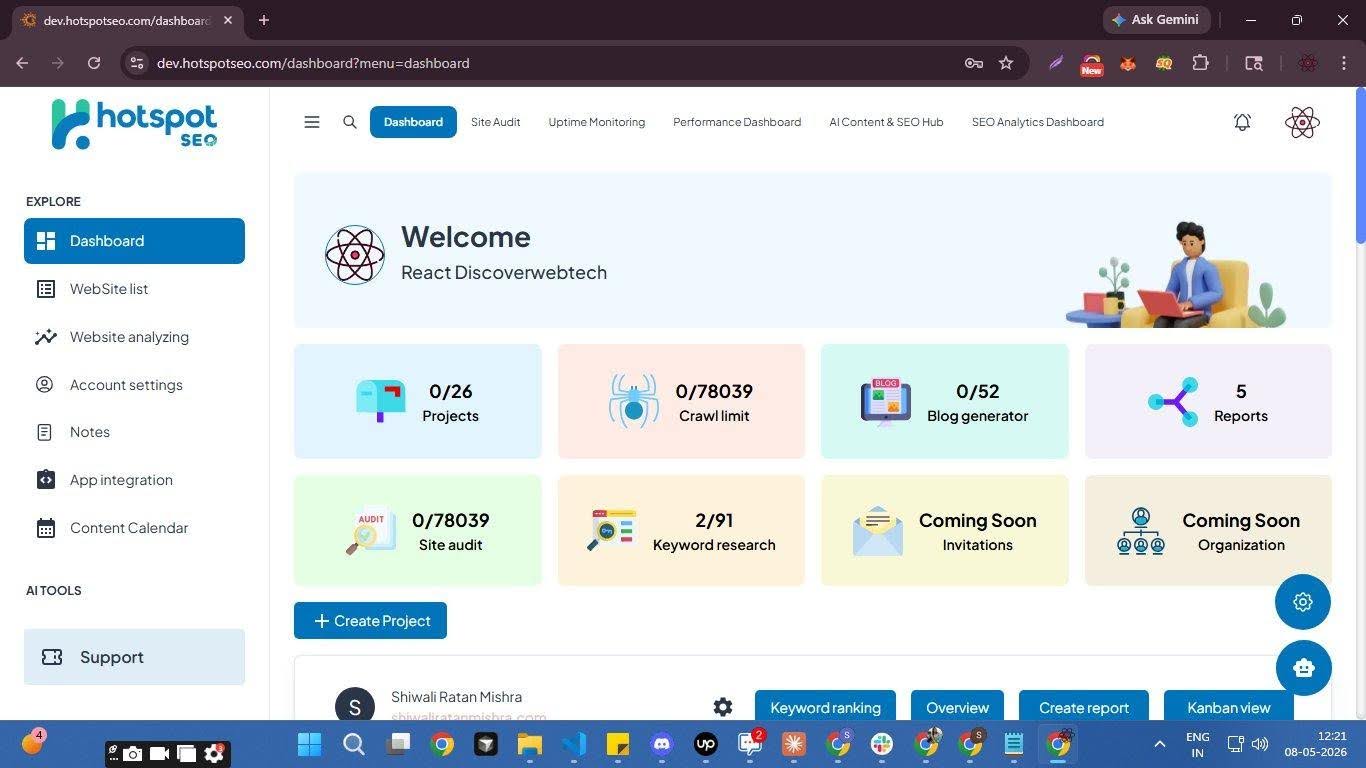
HotSpot SEO replaces the five-tab workflow with a single, calm dashboard that does the work of Screaming Frog, Pingdom, Lighthouse, an AI content suite, and a Google Analytics dashboard — all at once.
Designed for agencies, in-house SEO teams, and freelancers who manage multiple client websites. From a single workspace, users can crawl any website and get a health score, track uptime across all projects, benchmark Lighthouse performance across desktop and mobile, generate SEO-optimised content with AI, and pull live analytics from Google Search Console and GA4.
Everything is project-based — meaning each client website has its own audits, reports, and AI content history — and every tool shares the same navigation, making context-switching near-zero.
Site Audit Engine
Crawls every URL, returns a health score with Issues / Warnings / Notices.
Uptime Monitoring
24/7 server polling. Alerts before your client even notices the downtime.
AI Content Hub
Blog Generator, Content Writer, Planner & Keyword Research in one place.
GSC + GA4 Analytics
Unified view of Google Search Console and Analytics 4 data — one dashboard.
02 / The Problem
Too Many Tools. Too Little Context.
The average SEO team logs into seven different platforms before lunch. A site audit runs in one tool. Uptime alerts come from another. Page speed scores live in a third. Blog content gets drafted in a fourth. And analytics — the one thing that should tie everything together — sits in Google Analytics, disconnected from all of it. The result isn't just inconvenience. It's lost insight.
Pain 01 Five-Tool Sprawl
Pain 02 Siloed Data
Pain 03 Content Without Context
03 / The Solution
One Dashboard. Full-Stack SEO.
HotSpot SEO was built on a single premise: every SEO decision a team makes should be informed by data from the same place it was gathered. The platform unifies six distinct SEO disciplines into one product — not through an integration marketplace, but natively. Audit data informs content recommendations. Uptime history contextualises traffic anomalies. Lighthouse scores sit next to health scores. AI content tools have access to keyword research before they write a word.
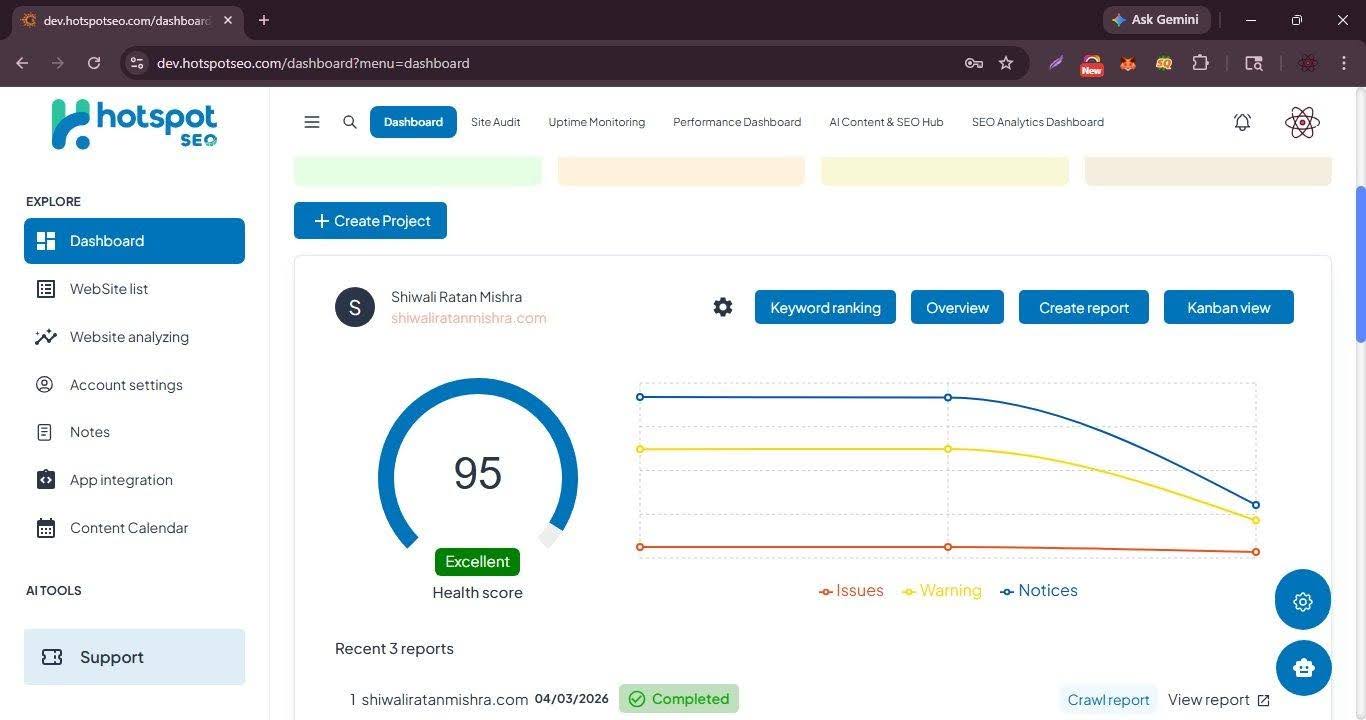
Health Score — the north star metric. Every project gets a single health score (0–100) calculated from crawl results. Excellent (90+), Good (70–89), Needs Work (below 70). The trend chart shows how the score has moved across audits — so improvement is visible at a glance.
04 / Site Audit
Crawl. Score. Fix. Repeat.
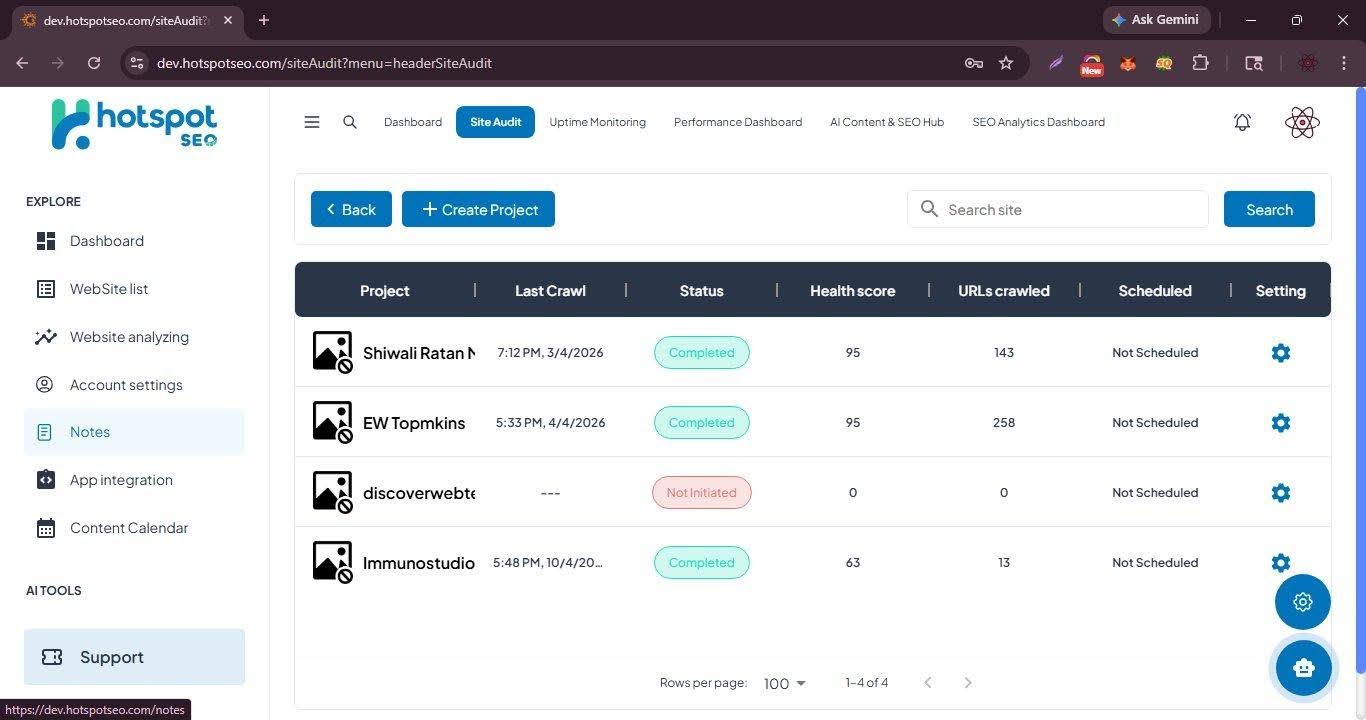
The Site Audit engine is the core of HotSpot SEO. It crawls every URL on a domain, flags technical issues, and returns a single health score with a breakdown across Issues, Warnings, and Notices.
Audits can be run on demand or scheduled — so clients always have a fresh report waiting. Each audit logs the crawl time, URL count, and health score, making it easy to see whether the fixes from last sprint actually moved the needle.
Weighted composite of all crawl findings. 95 = Excellent.
Critical problems that directly harm rankings or crawlability.
Mid-level signals that should be addressed but aren't blocking.
Low-priority observations — informational, not urgent.
Technical SEO
Broken links, missing meta tags, duplicate content, redirect chains flagged and prioritised.
On-Page Signals
Title lengths, heading structure, image alt text — everything that affects on-page relevance.
Crawlability
robots.txt validation, sitemap checks, canonical tags — ensures Google can reach every page.
Core Web Vitals
Flags pages likely to underperform on Lighthouse before you even run the performance audit.
05 / Uptime Monitoring
Know Before Your Client Does.
Downtime is an SEO problem as much as an availability problem. A site that disappears from search results because Google caught it offline during a crawl can lose rankings that take months to recover.
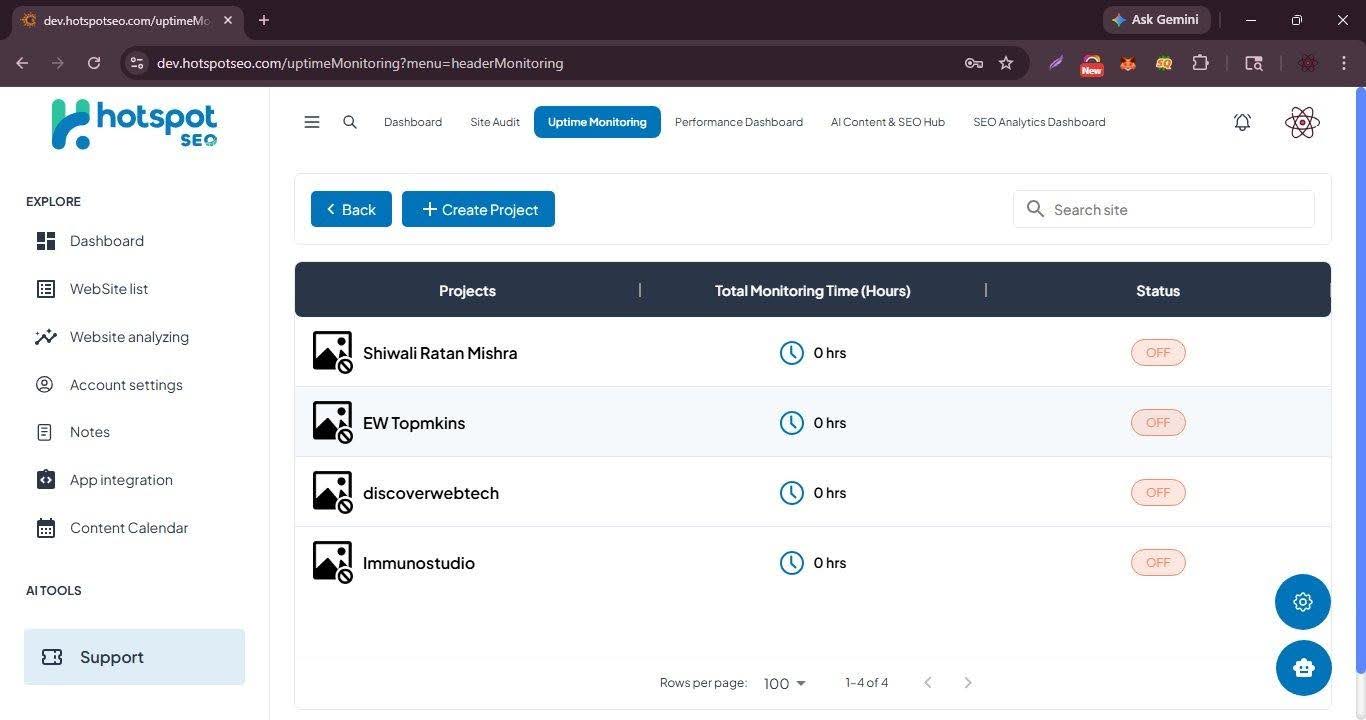
HotSpot's Uptime Monitoring module watches every project 24/7 and logs total monitoring hours. Alerts fire when a site goes down — so teams (or clients) find out in minutes, not days. The toggle-based interface makes it easy to turn monitoring on or off per project.
Downtime affects SEO rankings. Google's crawlers visit sites on a schedule. A server error during a crawl window can result in pages being de-indexed or losing crawl budget. HotSpot's uptime monitoring closes this blind spot — connecting availability data directly to the same platform tracking your site's health score.
06 / Performance Dashboard
Lighthouse Scores Across Every Project.
Core Web Vitals are a direct Google ranking factor. HotSpot's Performance Dashboard runs Lighthouse audits across all projects and surfaces the four scores that matter most — side by side, for both desktop and mobile. Desktop and mobile are tracked separately, because a site that scores 95 on desktop can score 40 on mobile — and Google ranks the mobile version first.
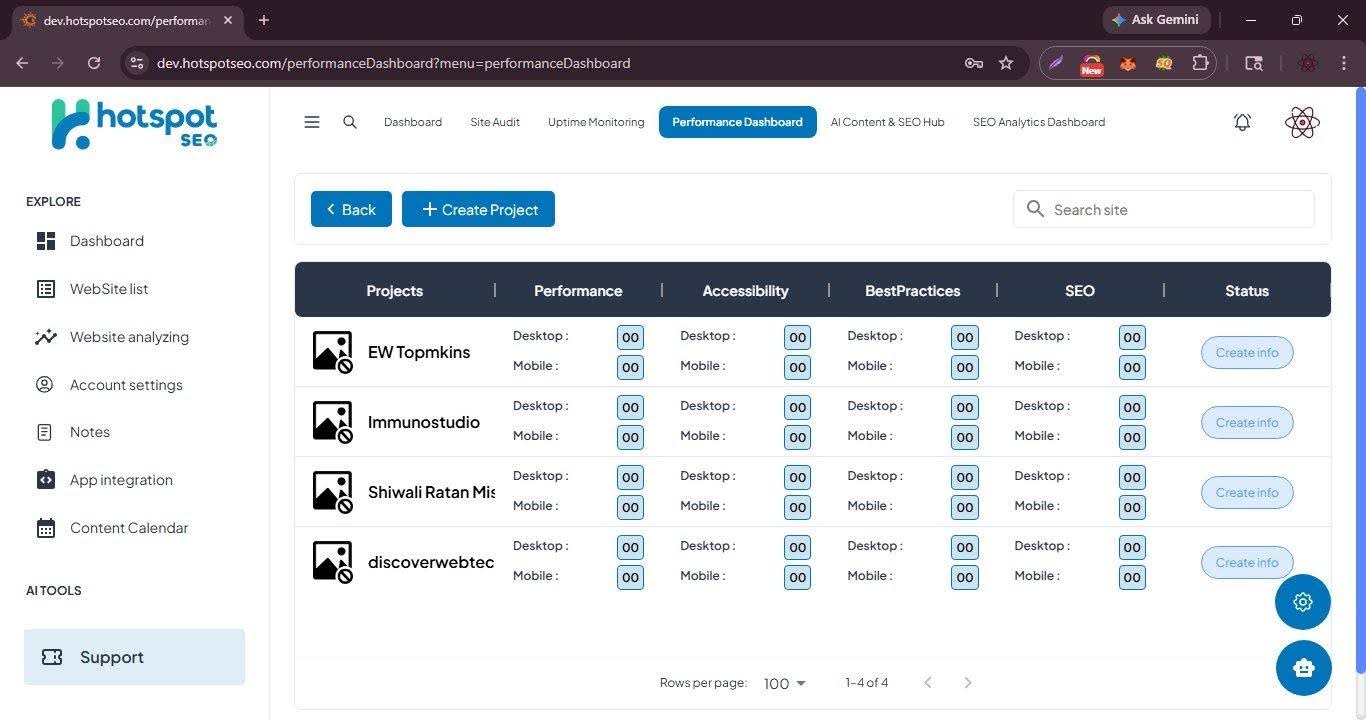
Score 01 Performance
Score 02 Accessibility
Score 03 Best Practices
Score 04 SEO
07 / AI Content & SEO Hub
Research → Plan → Generate → Optimise → Track.
Most AI writing tools are generic. HotSpot's AI Content Hub is built on top of the same keyword and audit data that powers the rest of the platform — so every piece of content it produces starts with context. The hub groups five distinct tools under one roof, each handling a different stage of the content workflow.
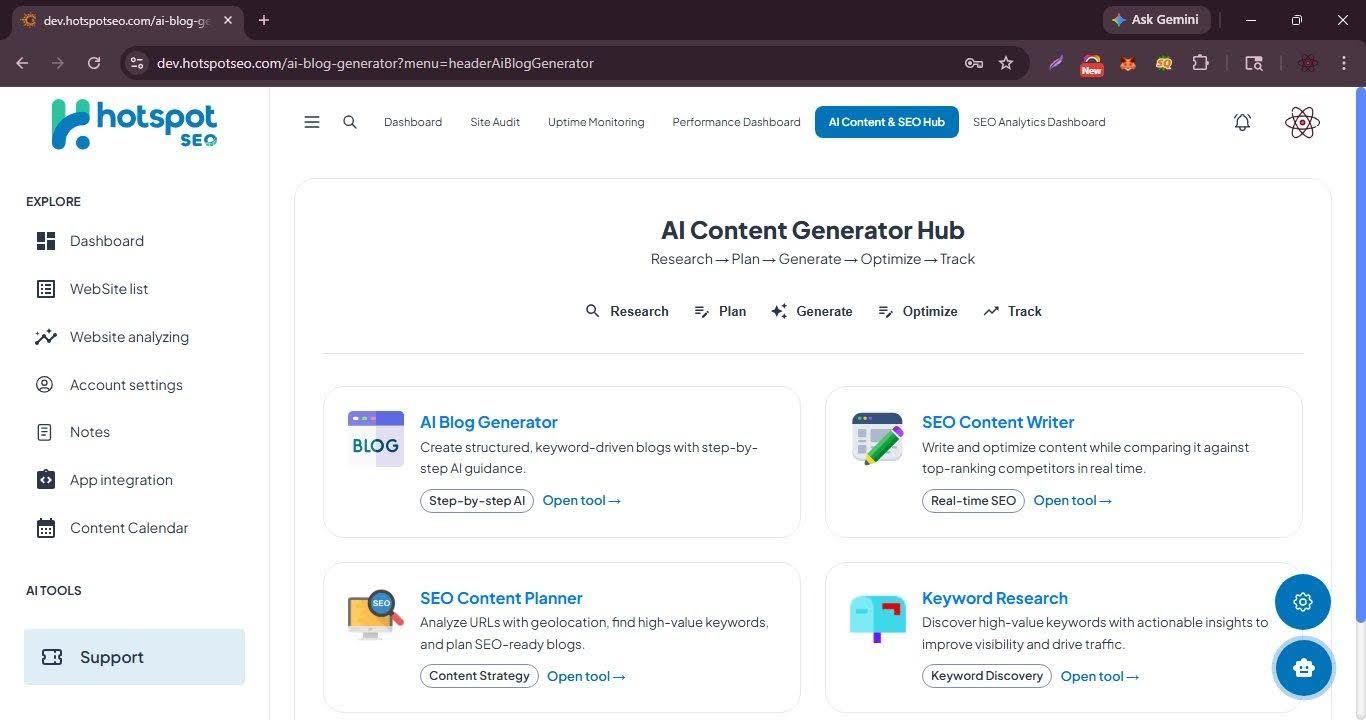
AI Blog Generator
Step-by-step wizard: enter up to 3 keywords, choose language and quantity, and get structured blog outlines with titles, intro paragraphs, and headings.
SEO Content Writer
Write and optimise content while comparing it against top-ranking competitors in real time. Built-in SERP analysis prevents generic output.
SEO Content Planner
Analyse URLs with geolocation filters, surface high-value keyword clusters, and plan a full editorial calendar of SEO-ready posts.
Keyword Research
Discover high-value keywords with search volume, difficulty, and opportunity scores to improve visibility and drive targeted traffic.
AI Blog Generator — Inside the Wizard
The Blog Generator guides users through a 4-step workflow — Target Keyword, Page Title, Intro Paragraph, Headings — so output is always structured and keyword-targeted.
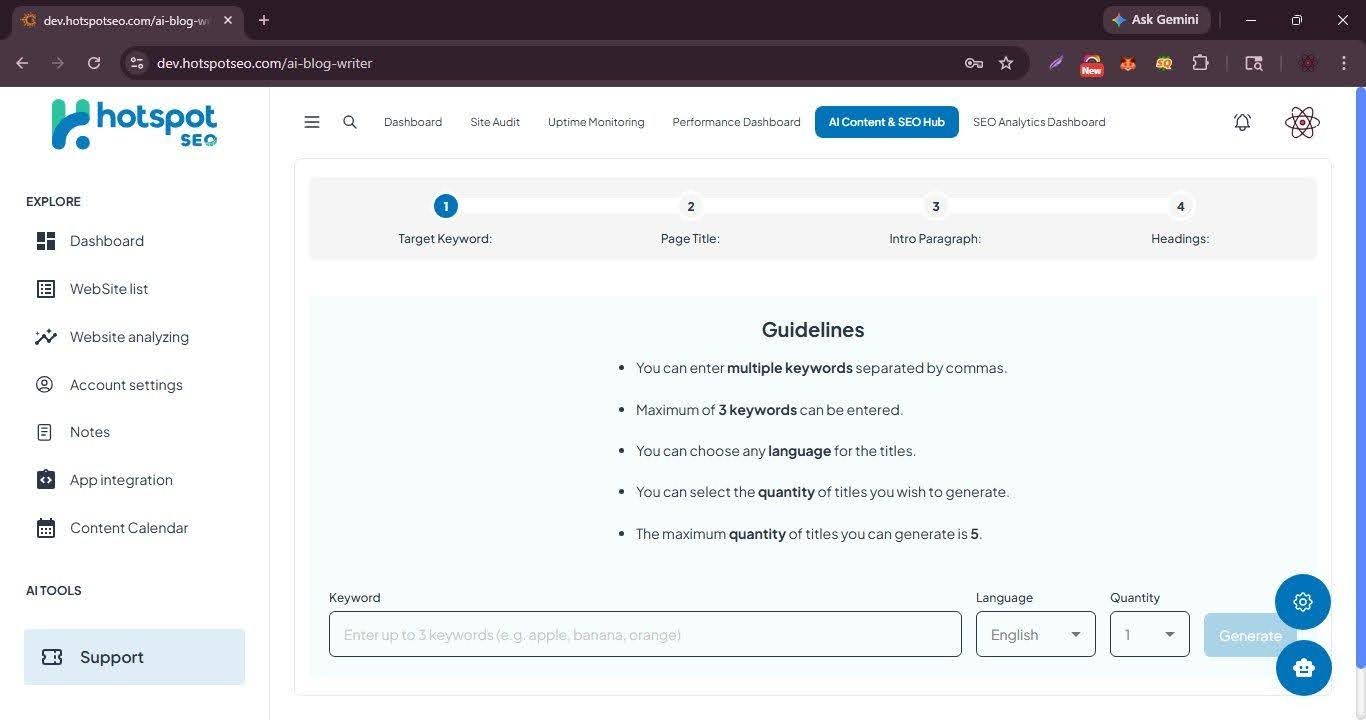
Why a wizard, not a blank prompt? Blank text boxes produce blank output. The Blog Generator wizard enforces structure at every step — keyword first, then title, then intro, then headings. The result is a brief a writer can follow, not a wall of AI-generated filler that needs to be deleted.
08 / SEO Analytics Dashboard
Google Search Console + GA4. One Place.
Every SEO insight lives somewhere in Google's ecosystem. The problem is getting it out — and getting it next to the audit data, performance scores, and content plans that should inform it. The SEO Analytics Dashboard solves this by connecting directly to Google Search Console and Google Analytics 4, then surfacing combined data as a single analytics view inside HotSpot.
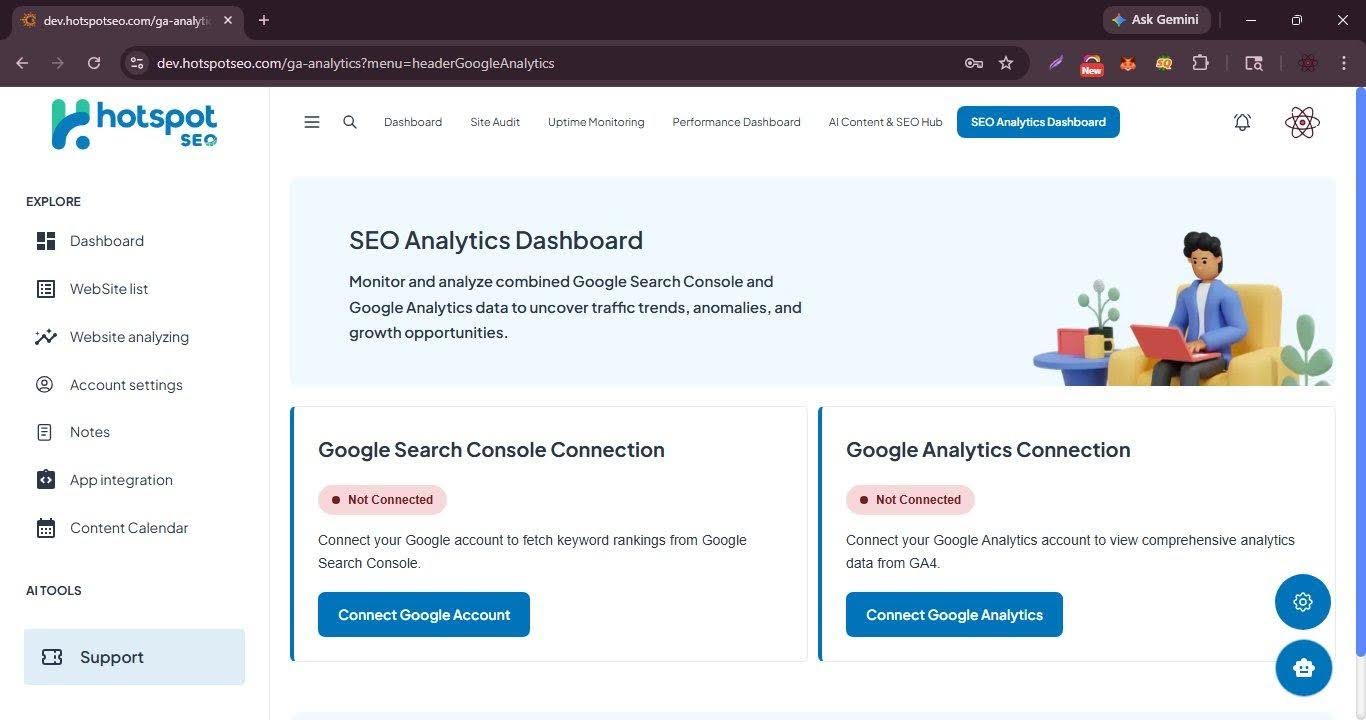
Integration 01 Google Search Console
Integration 02 Google Analytics 4
Why unified analytics matters. A traffic drop spotted in GA4 means nothing without knowing whether a crawl error was logged the same week. HotSpot connects both data streams so the relationship between technical health and traffic performance is always visible — in one dashboard, not two browser tabs.
09 / User Journey
From First Project to Full-Stack SEO Insight.
Add any domain. HotSpot creates a project workspace with its own audit history, uptime log, performance scores, content history, and analytics view.
Trigger a site crawl on demand or schedule it to run weekly. The engine returns a health score, flagged issues, and a full URL-level breakdown within minutes.
Switch on the uptime toggle for the project. The platform begins polling the server and logging availability hours — the first safety net for unexpected downtime.
Navigate to the Performance Dashboard to see Lighthouse results across desktop and mobile. Flag underperforming projects for Core Web Vitals remediation.
Use the Blog Generator to create keyword-targeted briefs. Feed the output into the SEO Content Writer to draft and optimise against live SERP competitors.
Link Google Search Console and GA4. The SEO Analytics Dashboard builds automatically — trend lines, KPI cards, anomaly flags, all reading from live Google data.
Generate a client report from the dashboard view. Audit results, performance scores, uptime history, and analytics are all available in one shareable report.
10 / Design Language
Confidence Through Clarity.
SEO dashboards are historically overwhelming. HotSpot's UI makes a different choice: one clear score per metric, one clear action per screen.
The product uses a deep-navy and sky-blue palette to signal authority without aggression — the visual language of a reliable professional tool, not a gamified metrics dashboard. Status is communicated through semantic colour (green for Completed, amber for warnings, red for issues) rather than icons that require a legend.
The sidebar navigation and tabbed header work together to give users two ways to navigate: by workflow (Dashboard, Site Audit, Performance, AI Content, Analytics) or by explore item (Website list, Notes, App integration). The result is an interface that reveals its depth gradually, rather than front-loading every feature on day one.
Design principle — confidence through clarity. One clear score per metric. One clear action per screen. The moment a user lands on a project dashboard, they know the answer to the only question that matters: is this site healthy? Everything else is detail — available when needed, never in the way.
11 / Outcome
Less Switching. More Knowing.
6
SEO disciplines unified — audit, uptime, performance, AI content, keyword research, and analytics — all in one platform.
4
AI content tools built-in — Blog Generator, SEO Content Writer, Content Planner, and Keyword Research.
2
Google integrations — Search Console for ranking data, GA4 for traffic and conversion analytics.
1
Health score per project — a single, clear north star metric (0–100) calculated from every crawl finding.
"The best SEO tool isn't the one with the most features. It's the one that makes your data talk to itself."
— Product thesis · HotSpot SEO
Ready to Replace Your Five-Tool SEO Stack?
We design and build SEO platforms that unify audit, uptime, performance, AI content, and analytics — with one health score to rule them all.