
Ransomware used to require a skilled hacker. Today, it requires a subscription.
The criminals behind the most damaging ransomware attacks of the past three years are not necessarily technical experts who built the tools themselves. Many of them are affiliates business partners who rent attack infrastructure, malware, and negotiation services from ransomware developers in exchange for a cut of the ransom payment. This model is called Ransomware-as-a-Service (RaaS), and it has done to cybercrime what SaaS did to software: lowered the barrier to entry dramatically, increased the volume of attacks, and distributed the risk across a professional criminal supply chain.
The numbers tell the story. According to the 2024 Verizon Data Breach Investigations Report, ransomware was involved in 23% of all breaches — and the median ransom payment crossed $220,000 for the first time. More concerning for mid-market organisations: Coveware’s 2024 Ransomware Report found that companies with 100–1,000 employees are now the most frequently targeted segment, having overtaken enterprise organisations as ransomware groups shifted strategy toward lower-resistance, higher-volume targets.
If you run or secure a mid-market organisation and you’re thinking “we’re too small to be worth targeting,” you have already accepted the most dangerous misconception in corporate security today.
This article explains how the Ransomware-as-a-Service economy actually works, why mid-market companies have become the preferred target, and the specific defence framework that gives your organisation a realistic chance of stopping an attack before it succeeds.
The Threat Landscape: How RaaS Actually Works in 2025
Understanding how to defend against ransomware requires understanding the business model behind it. This isn’t a lone hacker in a basement — it’s a professional criminal industry with division of labour, quality assurance, and customer service.
How the Ransomware-as-a-Service Model Works
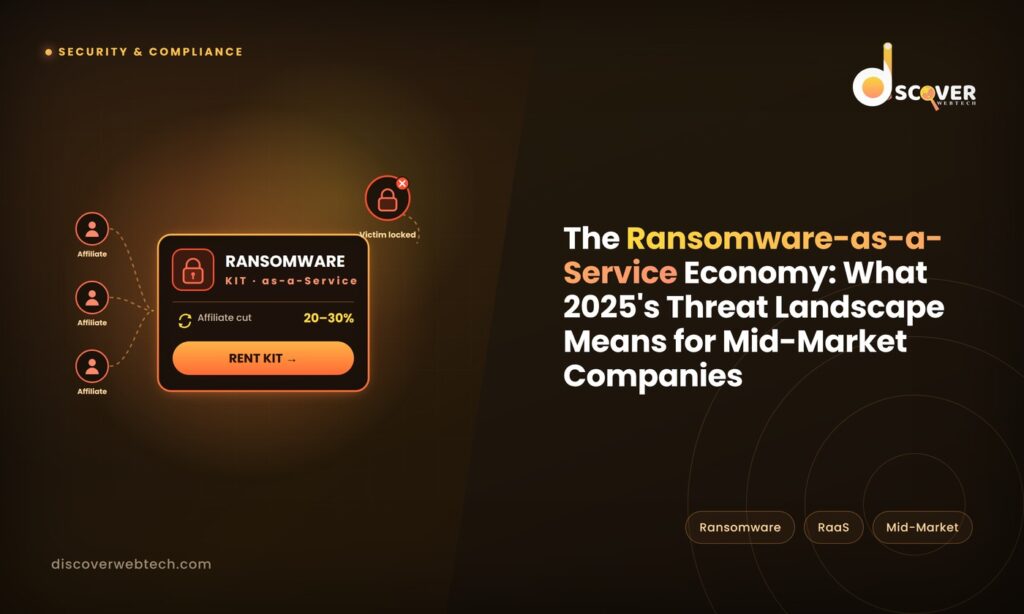
Think of RaaS the same way you’d think of a franchise business. The ransomware developer (the “core group”) builds and maintains the attack infrastructure: the malware itself, the encryption tools, the payment portal where victims pay ransoms, and the negotiation team that handles communications with victims. They then recruit affiliates and other criminals who use the infrastructure to conduct the actual attacks in exchange for 20–30% of every ransom collected.
For an affiliate, the barrier to entry is low. They don’t need to understand how ransomware works technically. They need to find a way into a target organisation — often by purchasing stolen credentials, exploiting a known software vulnerability, or conducting a phishing campaign and then deploy the ransomware kit they’ve licensed. The RaaS platform handles everything else: encryption, ransom demand generation, payment processing, and negotiation.
This model has several consequences that directly affect mid-market organisations:
Volume increases dramatically. Because affiliates can run multiple attacks simultaneously without building their own tools, the total number of ransomware incidents has grown sharply. More affiliates running more attacks means more organisations get hit.
Attacks require less sophistication. The technical complexity of conducting a ransomware attack has dropped significantly. Affiliates don’t need advanced hacking skills — they need access to a network and a few hours to deploy a pre-built toolkit. This lowers the bar for who can conduct an attack and dramatically increases the pool of potential attackers.
Mid-market organisations become preferred targets. Large enterprises have dedicated security teams, mature incident response capabilities, and backup systems that complicate ransomware attacks. Small businesses often have nothing worth paying for. Mid-market companies — with valuable data, real revenue, and security postures that haven’t kept pace with their growth — are increasingly the sweet spot.
Double Extortion: Why Paying the Ransom No Longer Ends the Problem
The original ransomware model was simple: encrypt the victim’s files, demand payment for the decryption key. If the victim had good backups, they could restore their data without paying, and the attack’s leverage evaporated.
Ransomware groups adapted. The dominant model in 2025 is double extortion: before encrypting the victim’s systems, the attackers first steal a copy of sensitive data. The ransom demand then has two components: pay to get your decryption key, and pay to prevent us from publishing or selling your stolen data.
Good backups no longer get you out of a ransomware situation. Even if you can restore your systems without paying for decryption, the threat to publish customer data, financial records, employee information, or intellectual property remains. The average victim is now paying two ransoms — one for decryption and one for data deletion — or facing consequences that go beyond operational disruption into legal liability, regulatory fines, and reputational damage.
For mid-market companies subject to GDPR, UK GDPR, or sector-specific data regulations, the data theft component of a ransomware attack can trigger regulatory notification obligations and potential fines entirely independent of whether the systems are restored. The ransomware attack becomes a data breach, which carries its own set of consequences.
Who Is Most Vulnerable and Why
Not all mid-market organisations carry equal ransomware risk. The groups most consistently targeted in 2025 share a predictable set of characteristics:
| Vulnerability Factor | Why Attackers Target It |
| Remote desktop access exposed to the internet | One of the most common initial access methods; scanning for exposed RDP takes seconds |
| Unpatched known vulnerabilities | Affiliates use automated scanners to find organisations running vulnerable software versions |
| No MFA on email or VPN | Stolen credentials bought for £50 on dark web forums provide immediate access |
| Flat networks with no segmentation | Once inside, attackers can move freely to find and encrypt the most valuable data |
| No offline or immutable backups | Removes the most effective recovery option, maximising ransom leverage |
| Small or no dedicated IT security team | Slower detection, slower response, longer dwell time for attackers |
If your organisation has two or more of these characteristics, you are a preferred target in the current threat landscape not because anyone is specifically planning to attack you, but because automated scanning tools will find you, and affiliates will deploy against targets their tools identify as vulnerable.
KEY TAKEAWAYS — The Threat Landscape
- RaaS turns ransomware into a franchise: developers build the tools, affiliates conduct attacks, both share the ransom
- Mid-market companies (100–1,000 employees) are now the most frequently attacked segment (Coveware, 2024)
- Double extortion means good backups alone no longer resolve a ransomware incident data theft creates separate liability
- Median ransom payment crossed $220,000 in 2024 (Verizon DBIR, 2024)
- Automated scanning identifies vulnerable organisations without any human deciding to target you specifically
Why Most Mid-Market Defences Are Falling Short
The Gap Between Perception and Reality
The most dangerous security gap in mid-market organisations isn’t a technical one. It’s the belief that existing controls are adequate when they aren’t.
A typical mid-market security posture in 2025 looks like this: antivirus on all endpoints, a firewall at the network perimeter, Microsoft 365 with basic security settings, and a backup solution that runs nightly. The IT team considers this “covered.” And against the threats of five years ago, it mostly was.
Against the RaaS threat landscape of 2025, it isn’t. Here’s why each layer fails:
Antivirus is designed to catch known malware based on signatures. Modern ransomware variants, especially those deployed by mature RaaS operations like LockBit, BlackCat/ALPHV, and Cl0p are regularly updated specifically to evade signature-based detection. Many successful attacks run for days or weeks before any antivirus alert fires.
Perimeter firewalls block traffic from outside your network. They do nothing once an attacker is inside and the most common initial access methods (phishing emails, stolen credentials, compromised VPN) don’t require breaking through a firewall at all.
Basic Microsoft 365 settings leave a number of high-risk configurations at their defaults. Without security-specific hardening, M365 environments are routinely compromised via phishing, legacy authentication protocols that bypass MFA, and over-permissioned application integrations.
Nightly backups are invaluable — but only if they’re offline or immutable and haven’t been compromised. Many ransomware operations now specifically target backup systems before triggering encryption, either deleting backups or encrypting them along with everything else. A backup stored on a network share accessible from infected endpoints is not a backup you can rely on.
What the Attack Chain Actually Looks Like
Most ransomware incidents follow a surprisingly consistent sequence. Understanding it helps you see exactly where your defences need to hold:
- Initial access (Days 1–3): The attacker gets into your environment. The most common methods in 2025 are phishing emails that deliver credential-stealing malware, brute-force attacks against exposed remote access systems, and purchased credentials from previous data breaches. This step often happens quietly no obvious disruption, no immediate alert.
- Persistence and reconnaissance (Days 3–14): The attacker establishes a foothold they can return to even if their initial access point is closed, then spends time understanding your environment. Where is your most valuable data? Where are your backups? Where are your administrative accounts? This phase is called the dwell time the period between initial compromise and the eventual ransomware deployment. The average dwell time in 2024 was 11 days, according to Mandiant’s M-Trends report.
- Privilege escalation (Days 7–14): The attacker moves from a limited user account to administrator-level access. This usually involves exploiting a vulnerability, cracking a poorly chosen password, or using a phishing technique against someone with admin credentials. With admin access, they can access backups, disable security tools, and move freely across the network.
- Data exfiltration (Days 10–20): Before deploying ransomware, the attacker copies your most sensitive data to their own systems. This is the data theft component of double extortion it happens quietly, often using legitimate tools like cloud sync clients to avoid triggering alerts.
- Ransomware deployment (Day 14–21): The attacker triggers the encryption, typically at a time designed to maximise damage and minimise response time — Friday night, a public holiday, the early hours of the morning. By the time anyone notices, encryption is complete and the ransom note has appeared.
The most important insight from this sequence: the attack is largely over before anyone knows it has started. By the time encryption triggers, the attacker has been in your environment for weeks, your backups may already be compromised, and your data has already been stolen. The response options available at that point are significantly worse than the prevention options available before it.
The Defence Framework: What Actually Stops Ransomware
No single control stops ransomware. The defences that work are layered multiple controls that each need to be bypassed for an attack to succeed. The goal is to make the attack expensive enough in time and effort that the attacker moves on to a softer target.
Layer 1: Prevention: Close the Easy Entry Points
The majority of ransomware initial access exploits the same small set of weaknesses. Closing them dramatically reduces the attack surface without requiring sophisticated security tooling.
Enforce MFA everywhere, without exceptions. Multi-factor authentication (requiring a second verification a code from a phone app, for example — in addition to a password) is the single most effective control against credential-based attacks. It doesn’t matter if your credentials are stolen if the attacker also needs your phone to use them. Enforce MFA on email, VPN, remote desktop access, and any cloud application containing sensitive data. According to Microsoft’s 2024 security report, MFA blocks over 99% of credential-based account attacks.
Patch known vulnerabilities promptly. RaaS affiliates use automated scanners that scan the entire internet for organisations running software with known vulnerabilities. The window between a vulnerability being publicly announced and attackers exploiting it at scale has shrunk to days in many cases. A patch management process that deploys critical security patches within 72 hours closes a large proportion of external attack surfaces.
Disable or restrict remote desktop access. Remote Desktop Protocol (RDP) exposed directly to the internet is one of the most exploited initial access vectors in ransomware attacks. If your organisation needs remote access, route it through a VPN with MFA rather than exposing RDP directly. If there are systems with exposed RDP that don’t need it, close the port.
Segment your network. Even if an attacker gains initial access, network segmentation limits how far they can move. A ransomware attack on a network with no segmentation can encrypt every connected system. On a segmented network, the attacker needs to separately compromise each segment which takes more time, creates more detection opportunities, and limits the blast radius of a successful attack.
Layer 2: Detection: Find Attackers During Their Dwell Time
Given that the average dwell time is 11 days, detection during the reconnaissance phase before data is stolen and before ransomware is deployed — is where the most valuable response opportunity exists.
Monitor for anomalous behaviour, not just known threats.
Antivirus looks for known malware signatures. Endpoint Detection and Response (EDR) tools look for behaviours that indicate compromise — a process accessing files it has never accessed before, a user account logging in at 3am from an unfamiliar location, administrative tools running from a user account that has never used them. For mid-market organisations, cloud-delivered EDR tools (Microsoft Defender for Endpoint, CrowdStrike Falcon, SentinelOne) provide enterprise-grade detection capability at mid-market price points.
Centralise and review your logs.
Your firewall, your VPN, your Active Directory, and your endpoints all generate logs that contain evidence of an ongoing attack if someone is looking at them. Many mid-market organisations generate logs but never review them. At minimum, implement automated alerting on the highest-risk log events: multiple failed login attempts, admin account creation, large-volume data transfers to external destinations.
Monitor for dark web credential exposure.
Credentials from previous data breaches are sold on dark web marketplaces and used for initial access in ransomware attacks months or years after the original breach. Services that monitor dark web forums for your organisation’s email domain and alert you when credentials appear let you force password resets before those credentials are used against you.
Layer 3: Response: Be Ready Before You Need to Be
The organisations that recover fastest from ransomware attacks are the ones that had tested response plans before the attack happened, not the ones that assembled a response team in a panic at 2am.
Maintain offline or immutable backups.
Your most critical data needs to be backed up to a location that ransomware cannot reach: either physically offline (external drives stored off-site) or cloud storage with immutable settings that prevent deletion or modification. Test your backups regularly a backup you’ve never restored from is a backup you can’t rely on.
Write and rehearse an incident response plan.
When ransomware hits, decision-making happens under extreme pressure in the middle of the night. Document the answers to these questions before you need them: Who gets called first? Who has authority to take systems offline? Who contacts your cyber insurer? Who handles external communications? Which systems are most critical to restore first? Run a tabletop exercise once a year where your leadership team walks through a ransomware scenario the exercise reveals gaps in the plan that aren’t visible until you actually try to execute it.
Know your cyber insurance coverage before you need it.
Cyber insurance has become a critical component of ransomware response, covering ransom payments (where legally permitted), incident response costs, legal costs, and regulatory fines. But policies have significant variation in what they cover and what they exclude. Review your policy specifically for ransomware coverage, exclusions related to security control requirements, and the claims process. The worst time to discover your policy has a gap is during an active incident.
KEY TAKEAWAYS — Defence Framework
- MFA is the single highest-impact prevention control it blocks over 99% of credential-based attacks (Microsoft, 2024)
- The average dwell time before ransomware deployment is 11 days detection during reconnaissance is your best response window
- Offline or immutable backups are non-negotiable backups accessible from infected endpoints will be encrypted too
- A written, rehearsed incident response plan dramatically improves recovery time and outcome
- Cyber insurance coverage should be understood before an incident, not during one
Implementation Priorities for Mid-Market Security Teams
Given limited resources and competing priorities, here is a realistic sequence for mid-market organisations looking to build meaningful ransomware resilience:
This week Highest impact, lowest complexity:
- Audit MFA enforcement across email, VPN, and remote access. Enforce it everywhere it isn’t already active.
- Check whether the remote desktop is exposed to the internet. Close any open RDP ports that don’t have an explicit business requirement.
- Verify your most recent backup and confirm it is offline or immutable and has been tested with a restoration.
This month Foundation controls:
- Deploy EDR on all endpoints. For Microsoft-centric environments, Microsoft Defender for Endpoint Plan 2 provides strong detection capability with minimal additional licensing cost.
- Review and harden Microsoft 365 security settings specifically, disable legacy authentication protocols, review application permissions, and enable advanced threat protection for email.
- Implement dark web credential monitoring for your email domain.
This quarter Structural resilience:
- Segment your network prioritise separating your most sensitive data and systems from general user workstations.
- Write your incident response plan and schedule a tabletop exercise with your leadership team.
- Review your cyber insurance policy specifically for ransomware coverage and exclusions.
Conclusion
Ransomware is no longer a threat that requires a sophisticated attacker to target your organisation specifically. It is an industrialised criminal business that runs automated scanning and opportunistic deployment at scale and mid-market companies are its preferred customers.
The good news is that the defenses that stop the overwhelming majority of RaaS attacks are not exotic or expensive. MFA, patching, EDR, segmentation, and offline backups address the root causes of successful attacks. The organisations that get hit are mostly the ones that haven’t implemented these controls not the ones that implemented them imperfectly.
Start with MFA. Verify your backups. Close your exposed remote access. Those three steps, done this week, reduce your ransomware risk more than any other investment you could make in the same timeframe.
📥 RANSOMWARE PREPAREDNESS SCORECARD A practical self-assessment for mid-market IT and security teams covering initial access controls, detection capability, backup resilience, and incident response readiness. Know where you stand before an attacker finds out for you. [Download the Free Scorecard → discoverwebtech.com/ransomware-preparedness-scorecard]
Frequently Asked Questions
Ransomware-as-a-Service is a criminal business model where ransomware developers build and maintain attack infrastructure the malware, payment portals, and negotiation services and then license access to affiliates who conduct actual attacks. Affiliates pay the developers 20–30% of every ransom they collect. This model has industrialised ransomware, dramatically lowering the technical skill required to conduct an attack and significantly increasing the volume of attacks across all target sizes. The most active RaaS operations in 2025 include LockBit 3.0, BlackCat/ALPHV, and Cl0p, among others.
Mid-market companies typically 100–1,000 employees have become the preferred ransomware target for a straightforward reason: they represent the best risk-adjusted return for attackers. Large enterprises have mature security teams, incident response capabilities, and legal resources that make attacks expensive and uncertain. Small businesses often don’t have data valuable enough to justify a significant ransom demand. Mid-market companies have valuable data and revenue, meaningful ransom capacity, and security postures that typically haven’t scaled alongside business growth. According to Coveware’s 2024 report, this segment now accounts for the highest volume of ransomware incidents globally.
Double extortion is a ransomware technique where attackers steal a copy of sensitive data before deploying encryption. The ransom demand then has two components: pay for the decryption key (to restore access to encrypted systems) and pay to prevent publication or sale of the stolen data. Double extortion changes response options significantly because having good backups previously the primary recovery strategy no longer removes all leverage. Even if you restore from backup without paying for decryption, the stolen data can still be published, creating legal liability, regulatory consequences, and reputational damage entirely independent of the operational recovery.
The three most common initial access methods in 2025 are: (1) credential-based attacks using stolen or guessed credentials against email, VPN, or remote desktop systems, often bypassing weak or absent MFA; (2) phishing emails that trick employees into installing credential-stealing malware or clicking links that exploit browser vulnerabilities; and (3) exploitation of unpatched vulnerabilities automated scanning tools identify organisations running software with known security flaws, and attackers exploit these before patches are applied. Of these, credential-based attacks are the most common and the most preventable MFA alone blocks the vast majority of them.
According to Mandiant’s M-Trends 2024 report, the median dwell time — the period between initial compromise and ransomware deployment — was 11 days. During this time, attackers conduct reconnaissance to understand the network, escalate their access privileges, locate and potentially destroy or compromise backups, and exfiltrate data for double extortion. This dwell time is why behavioural detection tools (EDR) that look for anomalous activity are so valuable they create a window to identify and evict attackers before the ransomware stage begins.
The immediate priority is containment: isolate infected systems from the network to prevent further encryption spreading. Specifically disconnect affected machines from the network (physically or by disabling network connections), do not turn off infected systems (forensic evidence is preserved in memory), and do not attempt to remove the ransomware manually. Then: notify your cyber insurer immediately (most policies have time-sensitive notification requirements), engage a cyber incident response firm if you don’t have internal capability, and do not communicate with attackers without specialist support. Avoid paying any ransom without legal and insurance guidance payment legality and policy coverage vary by jurisdiction and policy.
Most cyber insurance policies cover some ransomware-related costs, but coverage varies significantly between policies and insurers. Common inclusions are: incident response costs (hiring a forensics firm), ransom payments (subject to legal permissibility and insurer approval), business interruption losses during recovery, notification costs for affected customers, and regulatory defence costs. Common exclusions include: attacks exploiting vulnerabilities that had available patches, attacks facilitated by inadequate security controls (some policies specify minimum controls like MFA as coverage conditions), and nation-state attacks. Review your specific policy for ransomware coverage before an incident the worst time to discover a gap is during an active attack.