1. Introduction: The New Era of Smart Development
The way businesses build software is changing faster than ever. Today, it’s not just about writing long lines of code or hiring large tech teams. Thanks to the rise of low-code and no-code platforms, even people with little or no technical background can now create applications to solve real business problems.
But that’s not all. Artificial Intelligence (AI) is making this process even smarter. AI can now assist with everything from designing app interfaces to predicting user needs, helping businesses save time, cut costs, and innovate faster.
For small and medium-sized businesses (SMBs), this combination of AI and low-code/no-code tools opens up exciting new opportunities. It allows them to compete with larger companies, build solutions quickly, and adapt to changing customer demands without relying heavily on developers. We’re entering a new era where technology is more accessible, development is faster, and innovation is no longer limited to big tech players.
Table of Contents
2. Understanding Low-Code and No-Code Platforms
Building software used to mean writing thousands of lines of code and spending months developing an application. But with the arrival of low-code and no-code platforms, this process has become much simpler and faster. These platforms allow users to create apps through visual tools, drag-and-drop features, and ready-made templates instead of traditional coding.
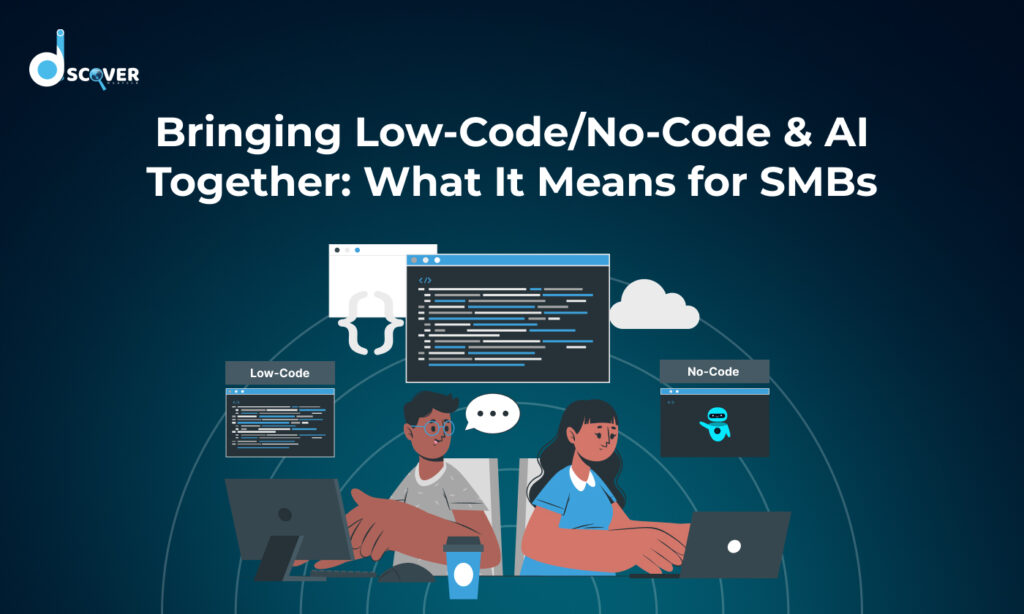
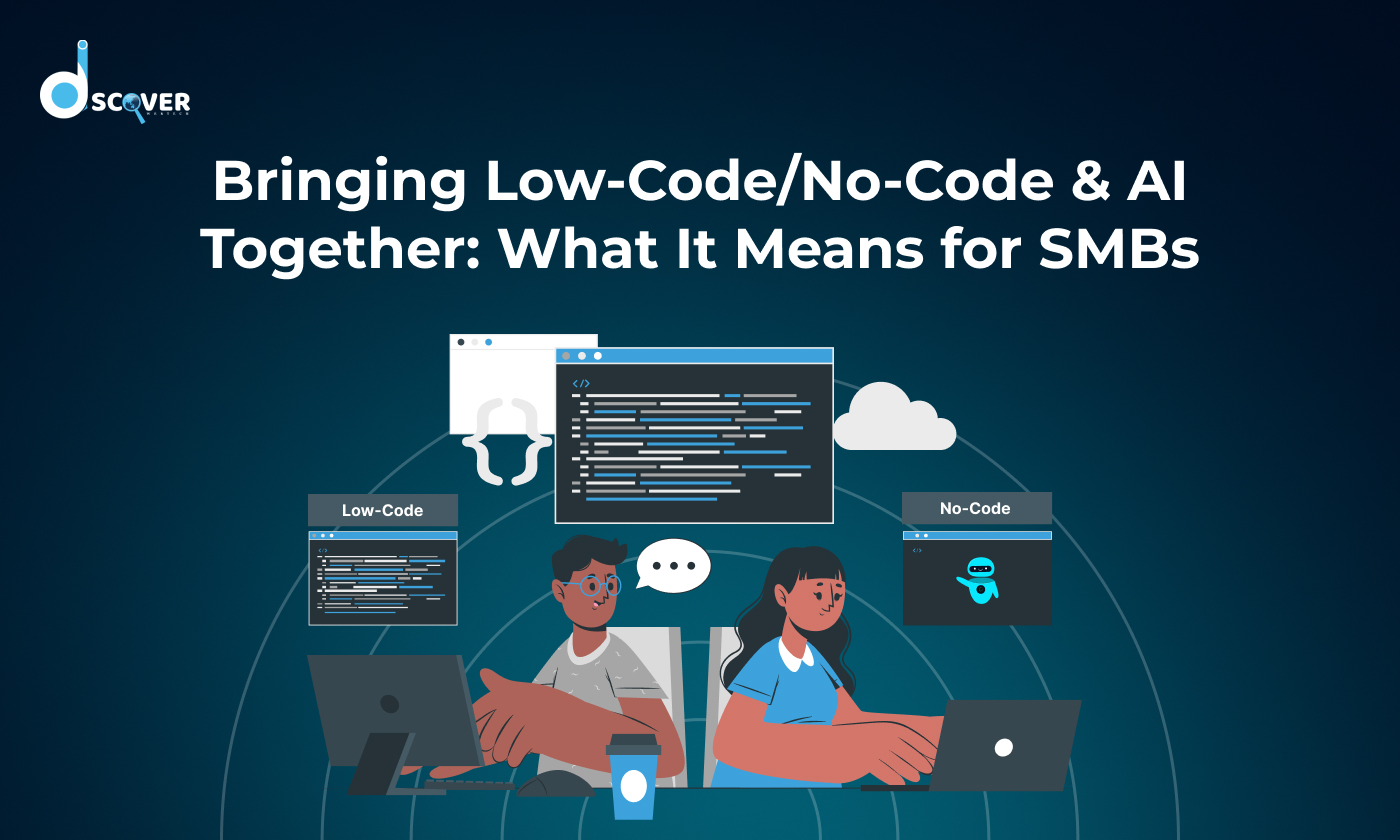
Both are designed to make software development more accessible, but they have a few differences that are important to understand.
2.1 What Makes Them Different
Low-code platforms are designed for developers or tech-savvy users who want to speed up development. They allow some coding for customization but still rely heavily on visual tools and pre-built components. This makes them ideal for businesses that need flexible, scalable applications without starting from scratch.
No-code platforms, on the other hand, are built for non-technical users. They require zero coding knowledge and focus on simplicity. Users can create apps just by dragging and dropping elements, filling in forms, and connecting data sources. These platforms are perfect for smaller businesses that want to automate workflows or build basic apps without hiring a developer.
Low-code gives more control and customization, while no-code offers simplicity and speed.
2.2 Why They’re Growing Popular Among Businesses
Low-code and no-code platforms are becoming popular because they save both time and money. Businesses no longer need large IT teams or long development cycles to bring their ideas to life.
Here are a few key reasons why companies are turning to these tools:
- Faster app creation: What used to take months can now be done in days or weeks.
- Lower costs: SMBs can develop digital tools without hiring full-time developers.
- More flexibility: Teams can quickly test, update, and improve applications.
- Empowered employees: Even non-technical staff can build tools to improve daily tasks.
With these benefits, it’s easy to see why low-code and no-code platforms have become essential for modern businesses looking to innovate quickly and stay competitive.
3. AI’s Expanding Role in Software Development
Artificial Intelligence (AI) is transforming the way software is built, tested, and managed. It is no longer just a tool for automation; it is becoming a creative partner for developers and businesses. From suggesting better code to predicting errors before they happen, AI is helping teams work smarter, not harder.
Let’s look at how AI has evolved from simple automation to intelligent decision-making and how it is making software development faster and more efficient than ever.
3.1 From Automation to Intelligence
In the past, AI in software development mostly focused on automation such as repetitive tasks like testing, code formatting, or deployment. It helped save time but still needed human control at every step.
Now, AI has become much more intelligent and adaptive. It can analyze massive amounts of data, understand user intent, and even make recommendations based on context. For example, AI-powered coding assistants like GitHub Copilot or ChatGPT can now generate functional code, detect bugs, and offer solutions in real time.
This shift from automation to intelligence means developers spend less time on manual work and more time focusing on strategy, design, and innovation. AI is not replacing developers; it is amplifying their creativity and efficiency.
3.2 How AI Supports Faster, Smarter Builds
AI accelerates every stage of the software development process. During the planning phase, it can analyze user requirements and suggest the best architecture or framework. In the coding stage, it helps by auto-generating code, detecting vulnerabilities, and ensuring best practices are followed.
When it comes to testing and deployment, AI tools can predict possible failures, automate regression testing, and ensure smooth rollouts with minimal errors. Even after launch, AI continues to monitor performance and user feedback to recommend improvements.
By integrating AI into development workflows, businesses can build high-quality applications in less time. For SMBs, this means faster innovation, reduced costs, and a greater ability to compete with larger companies.
4. Merging AI with Low-Code/No-Code Platforms
When Artificial Intelligence (AI) works together with low-code and no-code platforms, it completely changes how businesses develop software. This combination brings intelligence, speed, and simplicity to app creation. It helps users of all skill levels build smarter applications with minimal effort.
For small and medium-sized businesses, this partnership is a game changer. It allows them to save time, reduce development costs, and deliver high-quality apps that meet real business needs.
4.1 Enhancing Efficiency and Productivity
AI plays a key role in improving efficiency and productivity within low-code and no-code platforms. It handles many of the repetitive and time-consuming tasks that usually slow down developers.
Here’s how AI enhances performance:
- Automated Code Suggestions: AI can suggest or generate code instantly, reducing manual effort.
- Error Detection: It identifies mistakes in real time and recommends quick fixes.
- Workflow Optimization: AI helps streamline tasks like data mapping, testing, and deployment.
- Smart Recommendations: It suggests pre-built templates or components to speed up development.
- Resource Saving: With AI managing repetitive work, teams can focus on strategy and creativity.
These features help both technical and non-technical users build applications faster and more accurately, boosting overall productivity.
4.2 Streamlining Workflow and User Experience
AI also makes the development process smoother and more intuitive. It helps users design better applications by simplifying workflows and improving how apps look and function.
Here’s how AI helps streamline workflows and improve the user experience:
- Guided Assistance: Built-in AI assistants guide users step by step during development.
- Predictive Insights: AI predicts what users might need next, making the process more seamless.
- Data-Driven Personalization: It analyzes data to personalize app interfaces and features.
- Improved Design Suggestions: AI helps design user-friendly layouts that enhance engagement.
- Continuous Optimization: It monitors app performance and suggests improvements based on real-time data.
By combining AI with low-code and no-code platforms, businesses can create applications that are not only faster to build but also more intelligent and user-centered.
5. Benefits for SMBs Adopting AI-Powered Development
Small and medium-sized businesses (SMBs) often face challenges like limited budgets, smaller teams, and tight deadlines. Adopting AI-powered low-code and no-code platforms helps overcome these challenges by making software development faster, more affordable, and easier to manage. These tools combine human creativity with machine intelligence, helping businesses of all sizes build solutions that once required advanced technical expertise.
AI-powered development also empowers non-technical users to participate in app creation, reducing the dependence on specialized developers. This means more people in the company can contribute ideas, streamline workflows, and bring digital transformation to life without major investments. With AI handling many technical tasks, SMBs can focus on strategy, creativity, and customer experience instead of getting stuck in complex coding.
5.1 Faster Time-to-Market
Speed is crucial for any business trying to stay competitive. In today’s fast-moving market, the ability to launch products and updates quickly can make a big difference. AI-driven development tools automate repetitive tasks, generate instant solutions, and make collaboration between teams smoother and more efficient.
These platforms help developers and business users work together seamlessly, allowing businesses to respond faster to market trends and customer needs. Whether it’s building a mobile app, a website, or an internal tool, AI reduces the time between an idea and its execution.
- Automated Code Generation: AI can write code in seconds, reducing manual work.
- Instant Testing: AI-powered tools quickly identify bugs and errors during development.
- Smart Templates: Pre-built layouts and workflows help businesses launch applications faster.
- Faster Updates: AI assists in updating apps based on performance data and user feedback.
By reducing development time, SMBs can release products sooner, react quickly to market changes, and serve customers better.
5.2 Lower Development Costs
Building and maintaining software can be expensive, especially for smaller businesses that operate with tight budgets. AI-powered development tools reduce costs by minimizing human errors, automating manual coding, and accelerating overall development cycles. They also eliminate the need to hire large technical teams, which is often one of the biggest expenses for SMBs.
By adopting AI-driven platforms, businesses can build scalable and professional-grade applications at a fraction of traditional costs. This allows them to stay competitive with larger enterprises that have more financial resources.
- Reduced Need for Large Teams: Fewer developers are required since AI handles many coding and testing tasks.
- Faster Development Cycle: Less time spent means lower labor costs.
- Fewer Errors: AI detects bugs early, saving money on rework and maintenance.
- Reusable Components: Ready-to-use modules and templates eliminate the need to start from scratch.
These savings allow SMBs to invest more in innovation, marketing, or improving customer experiences.
5.3 Increased Flexibility and Innovation
Innovation is at the heart of growth, and AI makes it easier for SMBs to experiment with new ideas. Traditional development methods often require long planning and heavy coding, but AI tools remove these barriers. Businesses can now test new concepts, launch prototypes, and make changes in real time without depending on large IT departments.
AI-powered platforms also encourage creativity by offering insights, predictions, and smart recommendations. This helps teams build better solutions that meet customer expectations and adapt to changing market needs.
- Real-Time Insights: AI analyzes data and helps businesses make smarter decisions.
- Customizable Solutions: Apps can be easily modified as business goals evolve.
- Continuous Improvement: AI monitors user behavior and suggests upgrades for better results.
- Faster Experimentation: SMBs can test multiple ideas without heavy investment.
This flexibility helps businesses stay ahead of competitors and continually deliver better digital solutions for their customers.
6. Top AI-Integrated Low-Code/No-Code Platforms
As AI continues to reshape the way software is built, many low-code and no-code platforms have integrated smart features that make app development faster, easier, and more intelligent. These platforms combine automation, predictive insights, and natural language processing to help both developers and non-developers build high-quality applications efficiently.
For SMBs, choosing the right platform can make all the difference in scaling faster and staying competitive in a digital-first world. Let’s look at some of the leading platforms and what makes them stand out.
6.1 Leading Tools in the Market
Here are some of the most popular AI-powered low-code/no-code platforms making waves in 2025:
Microsoft Power Apps
One of the most widely used low-code platforms, Power Apps integrates deeply with Microsoft’s ecosystem. Its AI Builder feature allows users to automate workflows, process forms, and even predict outcomes using simple drag-and-drop tools.
OutSystems
Known for its enterprise-grade features, OutSystems offers AI-assisted development tools that suggest code improvements, detect security risks, and automate repetitive tasks. It’s ideal for companies looking for scalability and long-term support.
Mendix
Mendix uses AI and machine learning to guide users through the development process. Its “Mendix Assist” acts like a co-developer, providing intelligent recommendations and helping speed up application delivery.
Appian
Appian combines process automation, data integration, and AI capabilities in one platform. It’s especially useful for businesses that want to improve operational efficiency and customer service with minimal coding.
Google AppSheet
AppSheet is a no-code platform powered by Google Cloud that allows users to create apps directly from data sources like Sheets, Excel, or SQL. Its AI capabilities enable automated workflows and natural language data queries.
Zoho Creator
A flexible low-code platform that’s great for SMBs, Zoho Creator includes AI tools for data analysis, sentiment detection, and chatbot creation, helping users make apps that are both smart and interactive.
6.2 Features That Stand Out
Each of these platforms offers unique AI-driven features that help streamline and enhance the development experience. Here are the standout capabilities that make them valuable for SMBs:
- AI-Powered Automation
Simplifies repetitive processes like form submissions, approvals, and data handling, saving time and reducing manual effort. - Natural Language Processing (NLP)
Enables users to create or modify apps using plain English commands, making app building more accessible to non-developers. - Smart Recommendations
Suggests layouts, data connections, and design elements based on user input and project goals, ensuring consistency and efficiency. - Predictive Analytics
Helps businesses anticipate trends, identify bottlenecks, and make smarter decisions based on real-time data. - Seamless Integrations
Connects easily with tools like Google Workspace, Microsoft 365, and CRM systems, helping SMBs unify their workflows. - Built-In Security and Compliance
Many of these platforms use AI to detect vulnerabilities and ensure apps meet industry security standards.
7. Challenges and Considerations for SMBs
While AI-powered low-code and no-code platforms make software development more accessible, small and medium-sized businesses (SMBs) must also be aware of the challenges that come with them. These tools bring speed and simplicity, but they are not without limitations. Understanding these factors helps businesses make smarter decisions and ensure that the benefits of AI integration don’t come at the cost of control or security.
7.1 Data Privacy and Security Concerns
One of the biggest challenges for SMBs using AI-based development platforms is data privacy and security. Since most of these tools operate on cloud infrastructure, sensitive business and customer information is stored online. This can create risks if the platform’s security measures are not strong enough. Even though providers include encryption and compliance standards, the responsibility to manage data securely still lies with the business.
SMBs need to be cautious about where their data is stored and who can access it. Storing data on third-party servers may expose businesses to potential breaches, while relying on external plug-ins or integrations can create additional vulnerabilities. Compliance with privacy laws like GDPR or CCPA is also essential, especially for companies handling customer data across different regions. To minimize risks, SMBs should choose platforms that provide clear data protection policies, end-to-end encryption, and access controls. Regular system audits and employee awareness training can further strengthen security and prevent accidental data leaks.
7.2 Limited Customization and Skill Gaps
Another major challenge SMBs face when using low-code or no-code platforms is limited customization. These tools are designed to make app development simple, but this often comes at the cost of flexibility. Businesses that need highly tailored features or advanced functionalities may find these platforms restrictive compared to traditional coding environments. As a result, some apps may lack the depth or scalability needed for long-term growth.
In addition, while these platforms are user-friendly, they still require a basic understanding of how applications work. Non-technical users may struggle with setting up complex workflows, managing databases, or automating advanced processes. Without proper training, this can lead to inefficiencies or poorly optimized applications. Over time, businesses may also become dependent on vendors for updates, support, and new features. To address these issues, SMBs should consider hybrid solutions that allow partial coding, invest in team training, and plan ahead for scalability so their applications can evolve as their business grows.
8. Frequently Asked Questions (FAQs)
1. What are low-code and no-code platforms?
Low-code and no-code platforms are tools that allow people to create software applications with little or no coding knowledge. They use visual interfaces, drag-and-drop features, and ready-made templates, making it easy for anyone to build apps quickly without needing advanced programming skills.
2. How does AI improve low-code and no-code development?
AI makes these platforms smarter by automating repetitive tasks, suggesting better designs, detecting errors, and improving overall performance. It works like a helpful assistant that guides users throughout the app-building process, saving time and improving quality.
3. Why are AI-powered low-code platforms beneficial for SMBs?
For small and medium-sized businesses, AI-powered low-code tools help save time, cut costs, and make app creation easier. They enable teams to develop useful digital solutions without hiring large technical teams or investing heavily in software development.
4. Are low-code and no-code platforms secure?
Most of these platforms include built-in security features such as data encryption and access controls. However, since they work on cloud systems, SMBs should still take precautions by following privacy regulations, running regular audits, and choosing vendors that offer strong data protection.
5. Can AI-driven platforms replace human developers?
Not completely. While AI can manage repetitive and time-consuming tasks, human developers are still needed for creativity, complex problem-solving, and strategic decision-making. AI is designed to assist developers, not replace them.
6. What is the future of AI in low-code and no-code development?
The future looks exciting. AI will continue to make app creation faster, more accurate, and more intuitive. Soon, businesses may be able to build complete applications simply by describing their needs in plain language, making technology even more accessible to everyone.
9. Conclusion: Empowering SMBs with AI-Driven Simplicity
The combination of AI and low-code/no-code platforms is transforming how small and medium-sized businesses approach software development. What once required large budgets, technical expertise, and months of effort can now be achieved faster and more efficiently. These tools are giving SMBs the power to build, test, and launch applications without depending heavily on developers or IT teams.
AI is helping simplify complex processes by automating routine tasks, improving accuracy, and offering real-time insights. At the same time, low-code and no-code platforms make app creation accessible to everyone, allowing business owners, marketers, and managers to turn their ideas into working solutions. This shift not only saves time and costs but also fuels creativity and innovation across organizations.
While challenges such as data privacy and limited customization still exist, the benefits far outweigh the limitations when used wisely. As AI continues to evolve, it will make development even more intuitive and adaptable, helping SMBs stay competitive in a fast-changing digital world.
In the end, AI-driven low-code and no-code platforms are not just about building software faster, they are about empowering businesses to grow smarter, innovate confidently, and take control of their digital future.
Check out our latest blog on – “OpenAI announces the official launch of ChatGPT Atlas, its advanced AI-integrated web browser”