Why most SaaS companies are working twice as hard as they need to and what to do about it.
You Have Islands. You Need a Continent.
Here is a scene from inside most growing companies right now:
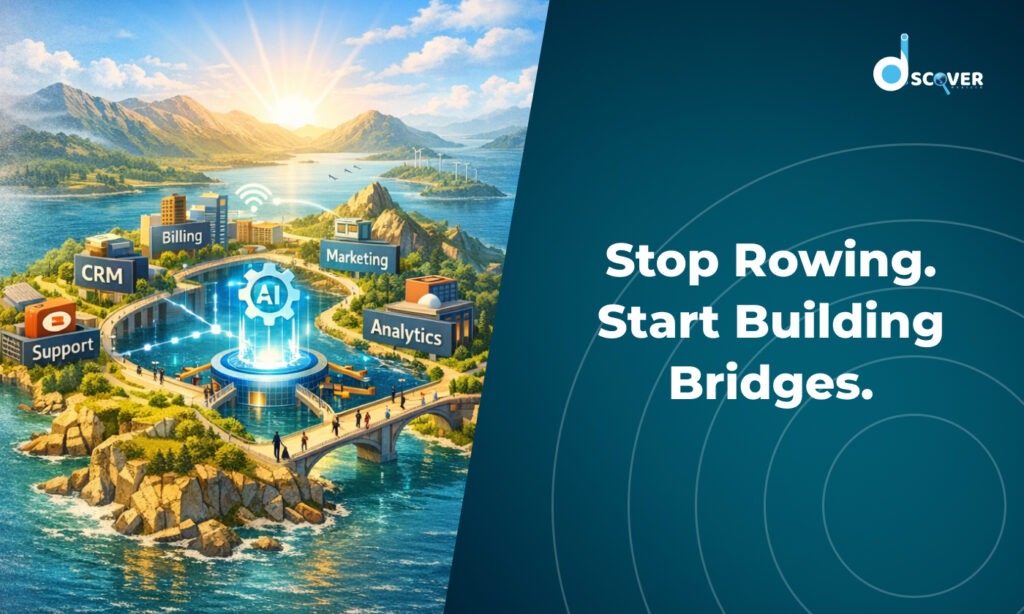
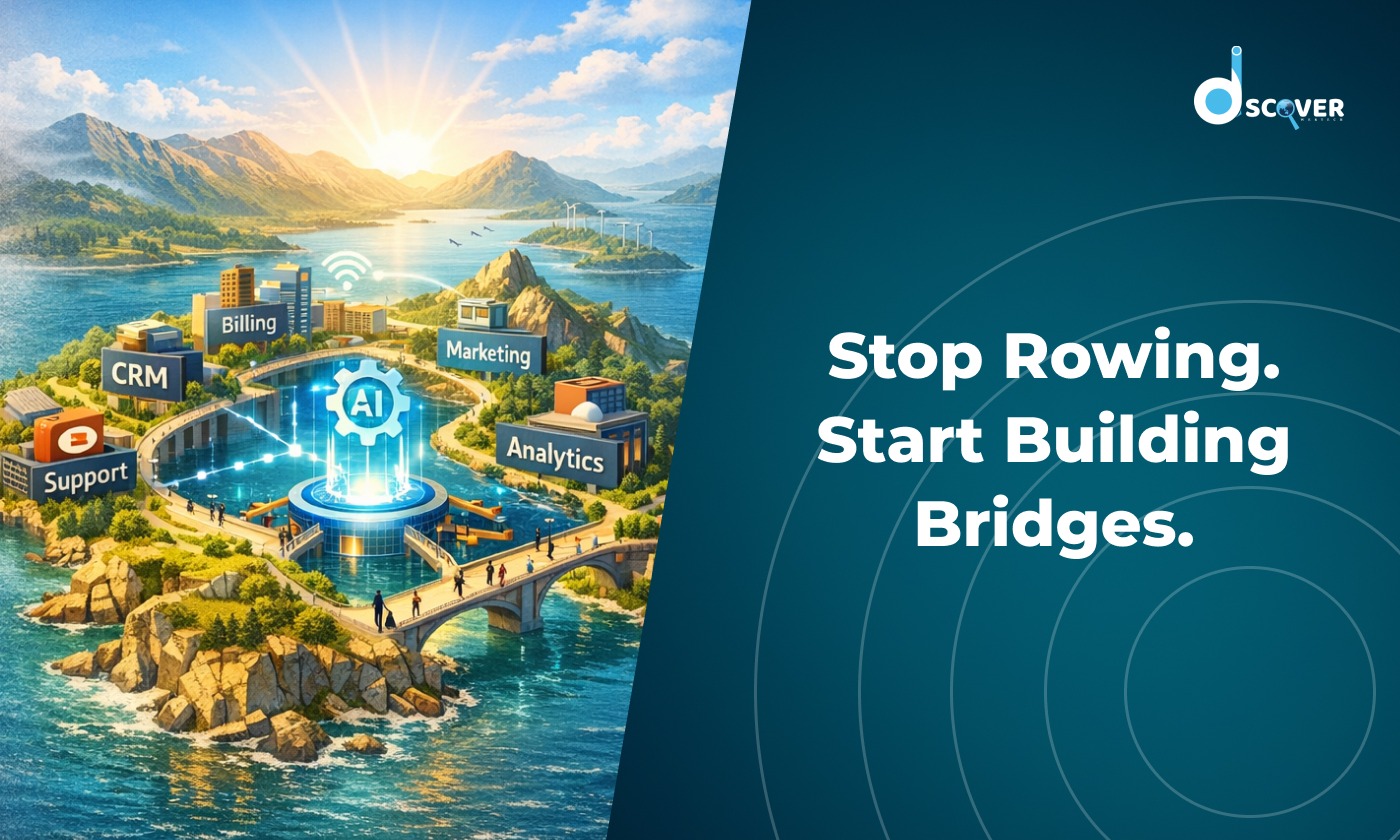
Your CRM sits in one corner. Your accounting software is another. Marketing tools over there. Customer support platform way over on the other side. Analytics somewhere in the middle. Each tool is great at its own job. But none of them talks to each other.
So what fills the gaps? People. Rowing between them.
Someone exports a spreadsheet from one tool and uploads it to another. Someone else copies and pastes a report into Slack. A manager rebuilds the same dashboard every Monday because the data just does not flow on its own.
This is what we call the Archipelago Effect a beautiful collection of software islands that, together, produce an enormous amount of invisible busywork.
“The average company uses 100+ SaaS tools. Most of them barely know each other.”
Meet the Rowing Boat Economy
The Rowing Boat Economy is what happens when software does not connect. Humans fill the gaps instead.
It looks like this:
- Time wasted: Hours spent each week just moving data from one tool to another.
- Mistakes made: Manual data entry means errors. Decisions get made on the wrong numbers.
- Speed lost: By the time data reaches the right person, it is already yesterday’s information.
The hidden cost here is not the software subscriptions. It is the smart, expensive people spending a chunk of their week doing work a computer could handle in seconds.
AI Can’t Help a Broken Map
Everyone is adding AI to their stack right now. And it is genuinely powerful when it works.
But here is the problem nobody talks about: AI is only as smart as the data you give it.
Imagine you deploy an AI tool to predict which customers are about to cancel. Sounds brilliant. But your AI can only see product usage data. It has no idea about billing issues, support complaints, or the fact that the customer’s main contact just left the company. So the AI gives you a confident answer built on half the picture.
That is a pilot flying with a broken map. Confidently heading in the wrong direction.
AI in SaaS only truly works when your systems are connected. Without that, you are just adding an expensive layer on top of a fragile foundation.
“AI is not the answer to a disconnected SaaS stack. A connected SaaS stack is.”
What Connected Actually Looks Like
Moving from islands to a continent does not mean replacing your tools. It means connecting the ones you already have.
The three moves that matter most:
1. Let your tools talk via APIs
Most modern SaaS tools have open APIs, meaning they are literally built to share data. When your CRM automatically updates when a support ticket closes, or your billing system syncs with your dashboard in real time, that is APIs doing the rowing for you.
2. Automate the boring bridges
SaaS automation is just setting rules: “When X happens in Tool A, do Y in Tool B.” No more manual exports. No more copy-paste. The system just handles it quietly, reliably, every single time.
3. Think ecosystem, not stack
A stack is a list of tools. An ecosystem is a system where every tool feeds into the others. When you add a new tool, the first question should be: how does it connect to everything else we already use?
Bridge-First: Build What You Have Before Buying More
Some of the most operationally sharp SaaS companies are quietly following a simple rule: connect before you buy.
Instead of adding a new tool to fix a problem, they first ask Can we solve this by connecting the tools we already have?
Teams working with this approach, like the integration specialists at DiscoverWebTech, start by mapping where data breaks down between existing systems. Often, the problem is not missing software. It is missing bridges. Fix the bridges first, and most operational headaches disappear.
It is a small mindset shift with a big payoff.
The Companies That Win Are Building Continents
The next few years will separate two kinds of SaaS companies: those operating a collection of islands, and those that have built a connected continent.
The continent companies will move faster. Their AI will actually work. Their teams will spend time on real work, not spreadsheet shuffling. And every new tool they add will make the whole system stronger, not more fragmented.
The island’s companies will keep rowing — and falling further behind.
“The companies that stop rowing between systems and start building bridges will always outrun those still managing islands.”