1. Introduction: Why Choosing the Right AI Approach Matters
Artificial Intelligence (AI) is no longer just a buzzword. It is now a real game changer for businesses of all sizes. From predicting customer behavior to writing content and automating customer service, AI has made it easier for companies to work smarter and faster.
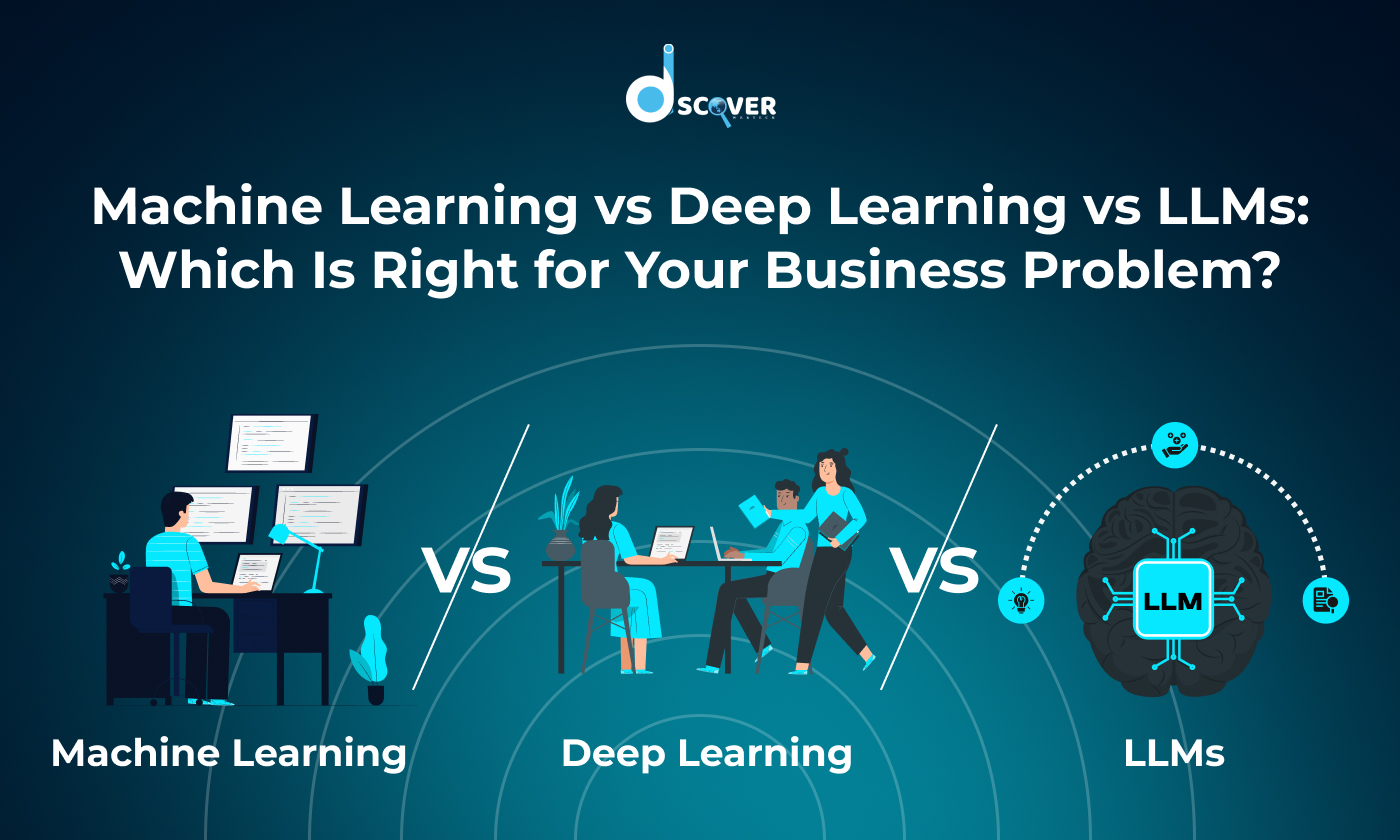
But here is the challenge: not every AI approach fits every problem. Some business tasks need simple prediction models, while others require complex systems that can think and learn from large amounts of data. That is why understanding the difference between Machine Learning (ML), Deep Learning (DL), and Large Language Models (LLMs) is so important.
Choosing the right one can make the difference between saving time and money or wasting both on the wrong solution. AI started as something very simple, just a set of rules and logic. Early systems followed human-written instructions like “if this happens, then do that.” These were helpful but limited because they could not learn on their own.
Then came Machine Learning (ML), which was a big step forward. Instead of just following rules, ML systems learned from data. For example, if you gave them sales data from the past year, they could predict next month’s sales.
Later, Deep Learning (DL) took it even further. It mimicked how the human brain works using something called “neural networks.” Deep Learning could recognize faces, understand speech, and even drive cars, all by learning patterns from huge amounts of data.
Now, we have entered the era of Large Language Models (LLMs), like ChatGPT and other advanced AI tools. These models do not just analyze data; they understand and generate human-like text. They can write articles, summarize reports, create code, and even answer customer questions in a natural way. This evolution shows how AI has become smarter, more flexible, and more human-like over time.
Table of Contents
2. Understanding the Three Core Technologies
To choose the right AI solution for your business, it is important to first understand how each technology works. Machine Learning, Deep Learning, and Large Language Models all belong to the same AI family, but they solve problems in different ways.
These technologies might sound similar, but the way they process information and make decisions can be very different. Knowing when to use which one can help your business save time, improve accuracy, and get the most value out of your data. By understanding the basics, you can make smarter decisions about how to use AI in real-world situations.
Each one has its own strengths, limitations, and ideal use cases. Let’s break them down one by one.
2.1 What is Machine Learning (ML)?
Machine Learning is the foundation of modern AI. It teaches computers to learn from data and make predictions without being programmed with exact rules.
For example, imagine you run an online store and want to know which customers are most likely to buy again. A Machine Learning model can study your past sales data, look for patterns, and predict which customers will return.
Machine Learning works best when:
- You have structured data (like numbers, sales records, or customer details).
- The goal is to find trends, predict outcomes, or classify information.
- You want quick and accurate results without needing massive amounts of data.
Common uses of Machine Learning:
- Predicting sales or demand
- Detecting spam emails
- Recommending products on e-commerce sites
Machine Learning is great for solving problems where data is clear and patterns are easy to detect.
2.2 What is Deep Learning (DL)?
Deep Learning is a more advanced form of Machine Learning. It uses multiple layers of artificial “neurons,” just like the human brain, to process information. These layers allow it to understand complex data such as images, speech, and videos.
For example, Deep Learning is used in facial recognition systems. It can study thousands of pictures and learn to identify faces, emotions, or even objects automatically.
Deep Learning works best when:
- You have a large amount of unstructured data (like images, videos, or audio).
- You want to handle complex problems that traditional models cannot solve.
- You can invest in powerful computers or cloud resources for training.
Common uses of Deep Learning:
- Image and speech recognition
- Self-driving cars
- Medical image analysis
In simple terms, Deep Learning is what gives AI its “brainpower.” It is powerful but requires a lot of data and computing power.
2.3 What are Large Language Models (LLMs)?
Large Language Models, or LLMs, are the newest and most advanced form of AI. They are trained on massive amounts of text from the internet, books, and articles, allowing them to understand and generate human-like language.
Unlike Machine Learning or Deep Learning models that focus on numbers or images, LLMs focus on words and meaning. They can read, write, summarize, translate, and even have conversations naturally.
For example, when you use ChatGPT to write content, answer questions, or create code, you are using an LLM.
LLMs work best when:
- You need AI to understand or generate natural language.
- You want automation in writing, customer support, or creative tasks.
- You prefer flexible, conversation-based interactions.
Common uses of LLMs:
- Chatbots and virtual assistants
- Automated content creation
- Summarizing or translating text
LLMs are designed to work with human language, making them ideal for businesses that rely on communication, content, or customer interaction.
2.3 Why Selecting the Right Method Depends on Your Business Goals
Choosing the right AI method is not just about using the latest technology. It is about finding the approach that fits your specific goals and data. Every business problem is unique, and each AI technology solves it in a different way. Understanding where Machine Learning, Deep Learning, or Large Language Models work best can save you time, money, and effort.
Each of these AI technologies has unique strengths, and the best choice depends on what your business wants to achieve. The table below will help you decide which approach fits your specific goal.
| Business Goal | Best AI Approach | Browser Support |
| Predicting sales, customer behavior, or trends | Machine Learning (ML) | Works well with structured data and can identify patterns or make predictions efficiently. |
| Analyzing images, videos, or voice data | Deep Learning (DL) | Designed to handle complex, unstructured data using advanced neural networks. |
| Automating conversations, content creation, or text summarization | Large Language Models (LLMs) | Specialized in understanding and generating human-like text for natural communication. |
3. How Each One Works (Explained Simply)
Now that you know what Machine Learning, Deep Learning, and Large Language Models are, let’s look at how each one actually works behind the scenes. Even though they all belong to the AI family, the way they learn, think, and produce results is quite different.
Each type of AI has its own learning process and purpose. Machine Learning focuses on analyzing structured data and identifying patterns. Deep Learning takes it a step further by using layered neural networks to understand complex information like images and sounds. Large Language Models specialize in processing and generating human-like text, making communication with machines feel more natural.
By understanding how each of these systems functions, it becomes easier to see how they complement one another in solving real-world problems, from predictive analytics and automation to natural language understanding and creative content generation.
3.1 How Machine Learning Processes Data
Machine Learning works by teaching computers to learn from examples instead of following fixed rules. You can think of it like training an intern. At first, you give them many examples and guidance. Over time, they start spotting patterns and can make smart decisions on their own.
Here is how Machine Learning works step by step:
- Data Collection: The first step is to gather data such as customer details, website traffic, or sales records. The quality and amount of this data directly affect how well the model performs.
- Data Preparation: The data is cleaned and organized. Any missing or incorrect information is fixed, and the data is formatted so that the model can understand it.
- Training the Model: The system studies the data and learns relationships between inputs and outputs. For example, it might learn that customers who view product A often buy product B.
- Testing and Evaluation: After training, the model is tested using new data it has never seen before. This helps check how accurate and reliable it is.
- Deployment and Improvement: Once the model performs well, it is used in real situations. Over time, it continues to learn from new data and improves its predictions.
Machine Learning is like a smart assistant that keeps getting better with experience. It is ideal for identifying trends, making forecasts, and helping businesses make data-driven decisions quickly.Example: A retail company can use Machine Learning to predict which products will sell more during the holiday season. The system studies past sales and customer preferences to make accurate predictions.
3.2 How Deep Learning Mimics the Human Brain
Deep Learning is inspired by how our brain works. It uses neural networks made of layers of digital neurons that process data in a way similar to how humans recognize patterns and make decisions.
You can imagine Deep Learning like peeling layers of an onion. Each layer of the neural network looks deeper into the data, understanding it in more detail.
Here is how it works:
- Input Layer: This is where the system receives raw data such as images, audio clips, or video frames.
- Hidden Layers: These layers are the core of Deep Learning. Each one processes the data and passes its understanding to the next layer. For example, in an image recognition system:
- The first layer might detect simple lines and edges.
- The next layer might recognize shapes like circles or squares.
- Deeper layers might detect complex objects like faces or cars.
- Output Layer: This is where the model gives its final result, such as identifying that an image contains a cat or recognizing a spoken word.
Deep Learning can find patterns even when humans cannot see them. It does not need someone to manually tell it what to look for because it automatically learns from the data.
Example: A hospital can use Deep Learning to analyze X-rays and detect early signs of diseases. The model can spot tiny details that doctors might miss, helping improve diagnosis accuracy.
Deep Learning is powerful, but it also needs a lot of computing power and large amounts of data to perform well.
3.3 How LLMs Understand and Generate Language
Large Language Models, or LLMs, work with text and language. They are trained on huge amounts of written content such as articles, books, and conversations to learn how humans write and speak.
What makes LLMs special is their ability to understand context and generate text that sounds natural and meaningful.
Here is how LLMs process information:
- Training on Text Data: The model reads billions of words from the internet and learns grammar, meaning, and relationships between words. For example, it learns that “coffee” is often connected with “morning” or “energy.”
- Understanding Prompts: When you type a question or command, the model breaks it into smaller parts called tokens and analyzes the meaning behind your words.
- Predicting the Next Word: LLMs work by predicting the next most likely word in a sentence. They repeat this process, building sentences that sound natural and relevant.
- Generating Responses: Using its training and understanding of context, the model creates a response that matches your tone, topic, and intent.
What makes LLMs even more impressive is their flexibility. They can switch writing styles, understand multiple languages, and even write computer code.
Example: A marketing agency can use an LLM to create ad copy, blog ideas, or social media captions in seconds. The model can adjust tone and style to match the brand’s voice perfectly.
LLMs are like conversation partners that understand and respond intelligently, helping businesses save time and communicate better.
4. Machine Learning in Action: Real-World Business Use Cases
Machine Learning (ML) has become one of the most powerful tools for businesses today. It helps organizations make smarter decisions by analyzing data and learning from it. From predicting customer behavior to improving marketing campaigns, ML can turn raw data into valuable insights that drive growth and efficiency.
What makes Machine Learning so effective is its ability to continuously improve as it processes more data. Instead of relying on fixed rules, ML models adapt to new trends, helping businesses stay relevant in changing markets. Whether it’s retail, finance, healthcare, or logistics, companies across industries are using ML to automate processes, reduce errors, and make decisions faster than ever before.
Let’s explore a few real-world use cases where ML truly shines.
4.1 Demand Forecasting and Predictive Analytics
One of the most common uses of Machine Learning is predicting future trends based on past data. For example, retailers use ML to forecast product demand during festive seasons or sales events. By analyzing patterns like sales history, customer preferences, and even weather conditions, ML models can predict how much stock will be needed.
This helps businesses avoid overstocking or running out of products, saving both money and resources. Similarly, manufacturers use predictive analytics to anticipate equipment failures before they happen, reducing downtime and maintenance costs.
4.2 Customer Churn Prediction
Customer retention is vital for any business, and ML makes it easier to spot when a customer is likely to leave. By studying data such as purchase frequency, customer support interactions, and engagement levels, ML models can identify early warning signs of churn.
For example, a telecom company can use ML to find customers who haven’t recharged in a while or have complained multiple times. Once identified, they can take quick action, like offering special discounts or better service, to retain those customers. This not only saves revenue but also strengthens customer relationships.
4.3 Recommendation Systems and Targeted Marketing
Ever noticed how Netflix suggests shows you might like or Amazon recommends products similar to what you’ve already viewed? That’s Machine Learning at work. ML-powered recommendation systems analyze user behavior, purchase history, and preferences to deliver personalized suggestions. In marketing, ML helps brands target the right audience with the right message at the right time. For instance, an e-commerce platform can show product ads that match a user’s recent searches, improving the chances of conversion.
Machine Learning helps businesses understand their customers better, optimize operations, and make data-backed decisions that lead to measurable results.
5. Deep Learning in Action: Powering Complex Applications
Deep Learning (DL) takes Artificial Intelligence to the next level by teaching computers to learn and make decisions like humans. It uses neural networks with many layers to understand patterns hidden within complex data such as images, sounds, or videos. Unlike traditional Machine Learning, which often relies on structured data, Deep Learning can handle huge amounts of unstructured data and deliver accurate, real-time insights.
Because of this, Deep Learning is behind many of the intelligent technologies we use every day, from facial recognition on smartphones to voice assistants like Alexa or Siri. Let’s look at a few major areas where Deep Learning is creating real impact.
5.1 Image and Video Recognition
Deep Learning plays a key role in image and video recognition, helping machines identify objects, people, or even emotions in visual data. For instance, social media platforms use it to automatically tag friends in photos, while healthcare systems use it to detect diseases in medical scans like X-rays or MRIs.
In the retail industry, deep learning models can analyze security footage to track customer behavior or detect unusual activities. Similarly, in autonomous vehicles, DL helps identify road signs, pedestrians, and obstacles, making self-driving technology safer and more reliable.
5.2 Speech-to-Text and Natural Sound Processing
Another popular use of Deep Learning is in speech recognition and sound processing. Virtual assistants like Google Assistant, Siri, and Alexa rely on DL models to understand spoken language and respond naturally.
These models are trained on thousands of hours of audio to recognize accents, tones, and background noise, allowing them to interpret speech with great accuracy. In business, companies use DL for transcription services, voice-controlled applications, and customer support chatbots that understand natural speech. It also helps in analyzing audio data for emotion detection and sentiment analysis.
5.3 Fraud Detection and Anomaly Identification
Deep Learning is also transforming the way organizations detect fraud and identify unusual patterns in data. In banking and finance, DL models analyze millions of transactions in real time to spot suspicious activity or potential fraud.
Unlike traditional systems that rely on fixed rules, Deep Learning continuously learns new fraud patterns, making detection faster and more accurate. Beyond finance, anomaly detection is used in cybersecurity to identify potential threats, in manufacturing to detect equipment faults, and even in healthcare to find abnormal patient data that could indicate early signs of illness.
Deep Learning is not just about automation, it’s about giving machines the ability to “see,” “hear,” and “understand” the world in ways that were once thought impossible. As it continues to evolve, it will open new possibilities for smarter, more connected, and more efficient systems across industries.
6. LLMs in Action: Automating Language and Understanding Context
Large Language Models (LLMs) are one of the most advanced forms of Artificial Intelligence today. They are designed to understand, generate, and respond to human language in a natural and meaningful way. By training on massive amounts of text from books, articles, and online conversations, LLMs learn how people communicate, ask questions, and share information.
What makes them truly powerful is their ability to understand context. They do not just look at words individually; they understand how those words fit together to express intent and meaning. This helps them create accurate and human-like responses. LLMs are now being used across different industries to improve communication, automate repetitive language tasks, and make information easier to manage.
Let’s look at a few practical examples where LLMs are making a big difference.
6.1 Conversational AI and Chatbots
LLMs power many of the chatbots and virtual assistants we use today. They help businesses deliver natural, human-like conversations for customer service, onboarding, and sales support. Unlike older chatbots that rely on fixed replies, LLMs understand what users actually mean, even when they phrase things differently.
For example, a banking chatbot can help users check account details, explain interest rates, or answer complex questions about loan terms. In healthcare, LLM-powered virtual assistants can help patients book appointments, understand lab reports, or get personalized health advice in real time. This makes customer communication faster and more satisfying.
6.2 Content Creation and Document Summarization
LLMs are also changing the way we create and manage content. They can write blog posts, emails, reports, and product descriptions quickly and with consistent quality. This helps content creators and marketing teams save time while maintaining clarity and tone.
Another powerful use of LLMs is document summarization. They can read long reports, meeting notes, or research papers and turn them into short, clear summaries. Professionals in every field can use this to understand large documents quickly without missing key information.
6.3 AI-Assisted Coding and Knowledge Management
LLMs are also improving productivity for software developers and knowledge-based teams. In coding, they act as smart assistants that suggest code snippets, fix syntax errors, and even explain how certain parts of the program work. This helps developers work faster and reduces the chances of mistakes.
For knowledge management, LLMs can organize company information, answer internal questions, and help employees find the right data instantly. Instead of searching through multiple documents, team members can simply ask a question and get an accurate answer within seconds.
Large Language Models are transforming the way humans interact with machines. By helping people communicate, learn, and create more efficiently, they are shaping the future of automation and intelligent work.
7. Comparing ML, DL, and LLMs (Key Differences)
Now that we have explored each technology individually, it is time to understand how Machine Learning (ML), Deep Learning (DL), and Large Language Models (LLMs) differ from each other. Although all three belong to the same Artificial Intelligence family, they vary in complexity, data requirements, and use cases.
Machine Learning focuses on analyzing structured data and finding patterns to make predictions. Deep Learning, on the other hand, is more advanced and deals with unstructured data like images, videos, and sounds through neural networks. Large Language Models are a step ahead, capable of understanding and generating natural human language by learning from massive text datasets.
Understanding these key differences helps businesses select the right approach based on their goals, resources, and the type of problem they are trying to solve.
| Aspect | Machine Learning (ML) | Deep Learning (DL) | Large Language Models (LLMs) |
| Data Type | Works best with structured data such as numbers, tables, and statistics | Handles unstructured data like images, audio, and videos | Focuses on text data such as sentences, documents, and conversations |
| Learning Method | Learns from features manually selected by humans | Learns automatically using multiple neural network layers | Learns language patterns and context from huge text datasets |
| Complexity | Moderate – easier to train and interpret | High – requires more computing power and large datasets | Very high – trained on billions of parameters for deep understanding |
| Use Cases | Sales prediction, customer churn, fraud detection | Image recognition, voice processing, medical imaging | Chatbots, text summarization, content generation |
| Hardware Requirement | Can run on standard machines | Needs GPUs for faster training | Requires large-scale computing and high-performance servers |
| Output Type | Predictive insights and data patterns | Object, sound, or pattern recognition | Natural and context-aware language output |
Each of these technologies plays a unique role in the AI ecosystem. Machine Learning is best for prediction-based tasks, Deep Learning is ideal for complex pattern recognition, and LLMs are perfect for language-based applications. Choosing the right one depends on your business problem and the type of data you have.
8. How to Choose the Right Approach for Your Business
With so many AI technologies available today, choosing between Machine Learning (ML), Deep Learning (DL), and Large Language Models (LLMs) can feel overwhelming. The best way to decide is not by following trends but by aligning the technology with your business needs, data, and goals. Selecting the right approach can save time, reduce costs, and lead to more accurate results.
Each business problem requires a different level of intelligence and data handling. Understanding how much data you have, the type of output you expect, and the level of automation you need will guide your decision. By evaluating your goals clearly and matching them with the right AI capability, you can build solutions that actually deliver measurable value instead of just sounding advanced.
8.1 Start with the Problem, Not the Technology
Before jumping into any AI solution, it’s important to clearly define the business problem you want to solve. Start by asking questions like:
- What challenge are we facing?
- What kind of outcome do we want to achieve?
For example, if your goal is to predict customer behavior, Machine Learning might be enough. But if you need your system to recognize images or understand natural language, Deep Learning or LLMs will be more suitable. Always let the problem guide your choice rather than the latest technology trend.
8.2 Assess Data Volume, Quality, and Complexity
Your data plays a major role in deciding which AI approach will work best.
- Machine Learning performs well with smaller, structured datasets where patterns are clear.
- Deep Learning requires large volumes of unstructured data like images, audio, or video to train effectively.
- LLMs need access to massive text-based datasets to understand language and context accurately.
If your data is limited or unorganized, you might start with ML and later move to more complex models as you gather more information. Always make sure your data is clean, labeled, and relevant before training any model.
8.3 Consider Goals, Timeline, and Budget
AI projects vary in cost, time, and complexity. Machine Learning is generally faster and more affordable to implement, making it a good fit for short-term or small-scale projects. Deep Learning and LLMs, however, require more resources, powerful hardware, and longer training periods.
If your business goal is quick optimization or prediction, start with ML. If you need deep insights from visual or language data, then investing in DL or LLMs may deliver better long-term value. Always balance your goals, available time, and budget before finalizing your approach.
The key is to start simple, stay focused on your goals, and choose the AI technology that aligns best with your data and business vision.
9. The Future of AI: Combining ML, DL, and LLMs for Smarter Systems
The future of Artificial Intelligence is not about choosing between Machine Learning (ML), Deep Learning (DL), or Large Language Models (LLMs), but about combining them to create smarter, more efficient systems. Each of these technologies has unique strengths, and when they work together, they can solve problems in ways that a single approach cannot.
Modern AI systems are already moving toward this direction. For example, a business might use Machine Learning for predictive analytics, Deep Learning for image processing, and an LLM to interpret or explain the results in natural language. This combination creates a more complete, intelligent, and human-like decision-making process.
9.1 Why Hybrid AI Systems Are Gaining Popularity
Hybrid AI systems combine multiple AI techniques to handle complex and multi-layered tasks. These systems are becoming more popular because they offer flexibility, better accuracy, and faster insights.
For instance, in healthcare, hybrid AI can use Deep Learning to analyze medical images, Machine Learning to predict patient outcomes, and LLMs to generate easy-to-understand medical reports. In business, combining these technologies allows organizations to automate workflows, improve customer experience, and extract meaningful insights from both numbers and language.
By using the strengths of each technology together, hybrid AI systems can adapt better to real-world challenges and deliver more reliable results.
9.2 The Importance of Human Involvement in AI Decision-Making
Even as AI becomes smarter, human involvement remains essential. Machines can process data and recognize patterns faster than humans, but they lack judgment, ethics, and emotional understanding. Humans play a critical role in guiding AI systems, interpreting their results, and ensuring decisions align with business goals and values.
For example, in financial services or healthcare, human experts are needed to validate AI predictions and ensure they are fair, transparent, and ethical. A balanced approach, where AI handles the data-driven tasks and humans focus on creativity, strategy, and oversight, leads to the best outcomes.
The future of AI will not be about replacing humans but empowering them. As ML, DL, and LLMs continue to evolve, businesses that combine these technologies thoughtfully with human expertise will lead the next wave of intelligent innovation.
10. Frequently Asked Questions (FAQs)
1. What is the main difference between Machine Learning, Deep Learning, and Large Language Models?
Machine Learning helps systems learn from data and make predictions. Deep Learning is a part of ML that uses neural networks to process complex data like images or speech. Large Language Models (LLMs) are advanced Deep Learning systems that understand and generate human-like text.
2. Can Large Language Models work without Machine Learning?
No, LLMs are actually built using Machine Learning and Deep Learning techniques. They are not a separate technology but an advanced form of ML and DL designed to handle large amounts of text and language-based tasks.
3. Why are hybrid AI systems becoming more popular today?
Hybrid AI systems combine multiple AI methods, like ML for prediction, DL for pattern recognition, and LLMs for language understanding. This combination makes systems more powerful, accurate, and capable of handling complex real-world problems.
4. Will AI ever replace human decision-making completely?
Not likely. While AI can analyze data faster and find patterns humans might miss, it cannot understand context, emotion, or ethics. Human judgment is still needed to make responsible and fair decisions, especially in areas like healthcare, finance, and law.
5. How can businesses benefit from combining ML, DL, and LLMs?
Businesses can use ML for predictive insights, DL for visual and speech recognition, and LLMs for communication and automation. Together, they create a complete AI ecosystem that improves customer experience, speeds up processes, and boosts productivity.
11. Conclusion: Focus on Business Value, Not Just Technology
Artificial Intelligence has become an essential part of modern business strategy, but its true success depends on how well it aligns with real-world goals. Machine Learning, Deep Learning, and Large Language Models each offer unique advantages, yet technology alone is not enough to create impact. What truly matters is how these tools are applied to address customer needs, optimize processes, and unlock new opportunities.
Businesses that focus on using AI to solve meaningful problems gain a lasting competitive edge. Instead of chasing every new trend, organizations should invest time in understanding their data, defining clear objectives, and selecting the right AI approach that delivers measurable value.
AI should be viewed as a long-term partner in business growth, not just a short-term experiment. With the right strategy, human expertise, and continuous improvement, companies can create intelligent systems that not only increase productivity but also inspire innovation and trust. The future belongs to those who use AI thoughtfully, focusing on outcomes that matter most to their customers and their business.
Check out our latest blog on – “Preparing for the Future: Web Dev Skills to Learn for 2026 and Beyond”