
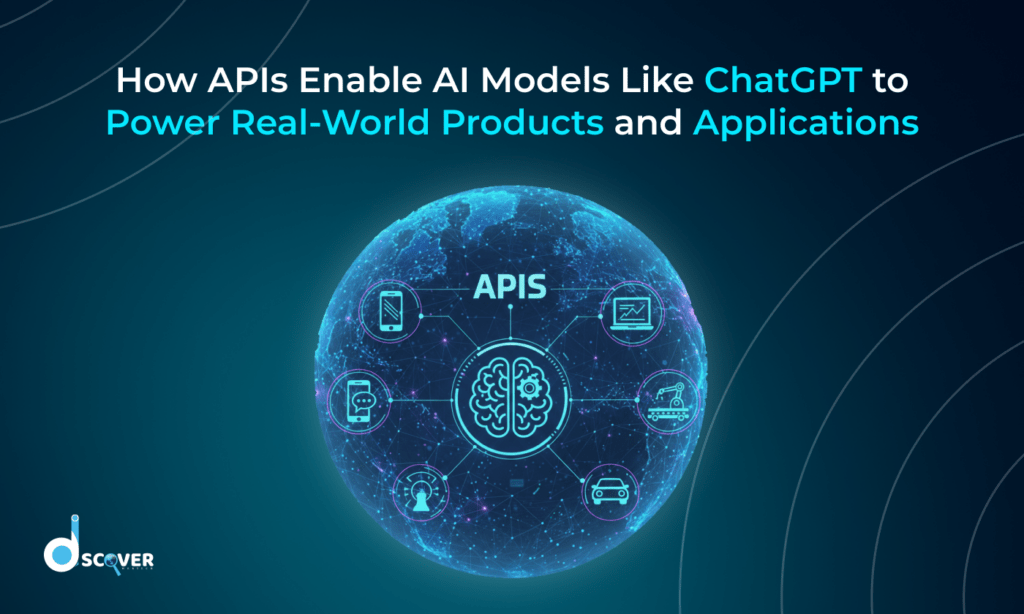
Artificial intelligence models like ChatGPT are no longer experimental tools limited to research labs. Today, they power customer support systems, content platforms, internal productivity tools, and full-scale SaaS products. But behind every seamless AI driven experience lies a critical technical layer that makes it all possible: APIs.
APIs act as the bridge between complex AI models and real-world applications. They allow frontend interfaces, backend services, and cloud systems to communicate with AI models securely, reliably, and at scale. Without APIs, even the most advanced AI model would remain isolated, unable to interact with users or integrate into production environments.
Table of Contents
Why APIs Are the Foundation of AI Powered Products
Artificial intelligence models are powerful on their own, but they cannot deliver value to users without a way to interact with real applications. APIs provide that connection. They act as the communication layer that allows AI models to receive inputs, process requests, and return responses in a structured and predictable way. Without APIs, AI would remain locked behind technical barriers, inaccessible to most products and users.
How APIs turn AI models into usable product features
APIs act as the bridge between powerful AI models and the applications that use them. When a user interacts with a product, such as typing a message into a chatbot, uploading data for analysis, or requesting content generation, the application sends that request to the AI model through an API. The API takes care of critical tasks such as authentication, formatting the data correctly, and routing the request to the AI model, ensuring that the model can process it accurately.
This layer of abstraction makes AI accessible and practical. Developers no longer need to manage the underlying infrastructure, training pipelines, or compute resources of the AI model. Instead, they can interact with it through simple, well-defined API calls, enabling them to focus on building product logic, designing smooth user experiences, and integrating AI seamlessly into workflows. In this way, AI functions just like any other backend service, alongside databases, payment systems, and messaging platforms.
How APIs Turn AI Models Into Usable Product Features
User Action Initiates Request
- A user interacts with the application, such as typing a message, uploading a file, or clicking a button.
- The application captures this input and prepares it to send to the AI model.
Application Sends Request Through API
- The frontend or backend sends the user input to the AI model via an API call.
- The API acts as the communication bridge, ensuring the data is transmitted securely and correctly.
API Handles Authentication and Security
- The API validates that the request comes from an authorized source.
- It ensures sensitive data is protected and complies with security protocols.
API Formats the Request for the AI Model
- Converts user input into the format that the AI model expects.
- Handles additional metadata, such as language preferences, context, or parameters.
AI Model Processes the Request
- The AI model generates a response based on the input received.
- This could be a text reply, data analysis, image generation, or any AI-powered output.
API Returns the Response to the Application
- The API receives the AI model’s output and converts it into a format usable by the application.
- The response is sent back to the frontend or backend system.
Application Delivers Output to the User
- The user sees the AI-generated result instantly in the application.
- The product now provides a feature powered by AI without the user ever needing to know about the underlying model or infrastructure.
The shift from isolated AI models to API driven ecosystems
Early AI implementations often lived in isolated environments, used for experiments or internal analysis. Modern AI powered products have moved far beyond that model. Today, AI operates as part of an interconnected ecosystem where APIs link models to frontends, databases, analytics tools, and third-party services.
This API driven approach enables scalability and flexibility. AI features can be updated, replaced, or extended without redesigning the entire product. Multiple applications can use the same AI model through standardized APIs, while different AI services can be combined to support complex workflows. This shift is what allows AI models like ChatGPT to power real world products reliably, securely, and at production scale.
Understanding How ChatGPT Works in Real Applications
AI models like ChatGPT are incredibly powerful, but they are not standalone applications. They require an environment that can process inputs, handle requests efficiently, and return results in a format that users and applications can understand. In real-world applications, ChatGPT relies on APIs and backend systems to make its intelligence usable, responsive, and scalable.
What happens when a user sends a prompt
When a user types a message or question into a chatbot, the application first captures that input and prepares it for processing. The input is sent to the backend system, which forwards the request to ChatGPT via an API. The model then processes the prompt using its trained neural network, generating a contextually appropriate response. Once the AI produces an output, the API ensures it is correctly formatted and sent back to the application, so the user sees an immediate response.
This entire process happens in milliseconds, giving the impression of real-time interaction, even though complex computations are happening behind the scenes. APIs and backend systems are what make this seamless user experience possible.
Why AI models cannot function directly without APIs
AI models like ChatGPT are designed to process data, not to interact directly with users or applications. They do not handle authentication, routing, data formatting, or user management on their own. Without APIs, developers would need to build complex systems around the model from scratch, including infrastructure management, request handling, and response formatting.
APIs abstract these complexities, allowing AI models to function as plug-and-play services. This means developers can focus on creating features, workflows, and user experiences, rather than worrying about the technical details of the AI model itself. In short, APIs are what transform raw AI intelligence into practical, real-world applications that users can interact with every day.
How APIs Connect Frontend, Backend, and AI Models
APIs act as the bridge connecting the frontend user interface, backend systems, and AI models like ChatGPT. They make it possible for applications to deliver AI-powered features quickly and reliably. Without APIs, the frontend would have no way to communicate with AI models, and the backend would struggle to handle requests, manage data, and maintain security.
The request and response flow explained simply
Here’s how a typical interaction works:
- User Input: A user types a message, uploads a file, or clicks a button in the frontend application.
- Backend Preprocessing: The backend validates the request, adds context if needed, and prepares the data for the AI model.
- API Request: The backend sends the formatted request to the AI model via the API.
- AI Processing: The AI model generates a response based on the input.
- API Response: The API sends the output back to the backend.
- Backend Post-Processing: The backend may format, filter, or enrich the response to make it ready for the frontend.
- Frontend Display: The user sees the AI-powered response instantly, creating a seamless interactive experience.
This entire flow happens in milliseconds, making AI interactions feel real-time and natural.
Role of backend systems in managing AI interactions
The backend is the engine that keeps AI features running smoothly. While the frontend focuses on user experience, the backend handles the heavy lifting behind the scenes. It ensures that AI models respond quickly, securely, and reliably, even when thousands of users interact at the same time.
The backend plays a crucial role in ensuring AI features work reliably and efficiently:
- Authentication and Security: Ensures only authorized requests reach the AI model.
- Performance Management: Handles rate limits, caching, and load balancing to maintain fast response times.
- Monitoring and Logging: Tracks API usage, errors, and performance metrics to maintain quality.
- Scalability: Allows AI features to handle growing numbers of users without affecting performance.
Together, APIs and backend systems turn raw AI intelligence into practical, user-friendly features. The frontend only needs to focus on delivering a smooth user experience, while the backend and API handle the complex work behind the scenes.
API Architecture Behind AI Powered Products
To make AI models like ChatGPT work seamlessly in real-world applications, a solid API architecture is essential. The architecture defines how the frontend communicates with the backend, how the backend interacts with the AI model, and how the system scales to handle multiple requests efficiently. A well-designed API architecture ensures reliability, performance, and flexibility for AI-powered features.
Core components of an AI ready backend
An AI-ready backend typically includes several key components that manage the flow of data between users and AI models:
• API Gateway: Serves as the entry point for all requests, managing authentication, routing, and load balancing.
• Request Handler: Processes incoming requests, validates data, and prepares it for the AI model.
• AI Model Interface: Connects to the AI model through APIs, handling communication and formatting responses.
• Database and Storage: Stores user inputs, AI outputs, logs, and other necessary metadata.
• Monitoring and Logging Tools: Tracks system performance, API usage, and errors to maintain reliability.
REST and event-driven APIs in AI systems
REST APIs are commonly used in AI applications because they are simple, standardized, and easy to integrate. They allow developers to send requests and receive responses in predictable formats like JSON.
Event-driven APIs are useful when AI features need to react to specific events, such as a new user registration or a file upload. These APIs trigger backend processes automatically, making AI systems more responsive and scalable.
In many AI applications, REST and event-driven APIs are often used together to create a robust and flexible system. REST APIs handle predictable, real-time requests, while event-driven APIs manage background tasks and triggers. This combination ensures that AI-powered products can deliver fast, reliable, and seamless experiences to users, while also handling complex workflows and scaling efficiently as demand grows.
When GraphQL fits AI driven applications
GraphQL APIs are ideal when clients need flexibility in retrieving data from AI models. Unlike REST, which delivers fixed response structures, GraphQL allows applications to request exactly the data they need, reducing unnecessary load and improving performance.
Using GraphQL in AI-driven applications is especially helpful for dashboards, analytics tools, or multi-feature platforms where clients need dynamic, custom responses from AI models. It allows developers to combine multiple data sources into a single query, eliminating the need for multiple API calls and speeding up the delivery of AI-powered insights.
GraphQL also makes it easier to evolve AI applications over time. As new AI features are added, clients can access them without requiring changes to existing endpoints or breaking older functionality. This flexibility helps maintain a consistent user experience, reduces backend complexity, and supports scalable AI architectures that can grow with user demand and product requirements.
Real World Products Using ChatGPT Through APIs
APIs allow developers to integrate AI models like ChatGPT into real-world applications efficiently. By connecting AI models through APIs, businesses can leverage advanced intelligence without managing the underlying infrastructure. This capability has unlocked a wide range of applications across industries, from customer support to content creation and internal productivity tools. Using APIs, ChatGPT becomes a practical feature that scales easily, responds quickly, and delivers personalized experiences to users.
Customer support and conversational interfaces
AI chatbots powered by ChatGPT APIs are transforming the way businesses handle customer interactions. Instead of relying solely on human agents, companies can provide instant, 24/7 support to customers across multiple channels. With APIs, the backend can manage session histories, user data, and context, allowing the AI to respond intelligently to complex queries. This leads to faster resolution times, higher customer satisfaction, and reduced support costs.
• AI chatbots for websites and mobile apps
• Round-the-clock support without extra staff
• Context-aware conversations for personalized responses
• Integration with CRM systems for seamless customer data access
Content creation and marketing automation
ChatGPT APIs have become a powerful tool for content creation and marketing automation. Companies can generate blog posts, social media updates, email campaigns, and product descriptions at scale. By integrating AI through APIs, businesses can also personalize content based on user behavior and preferences. Additionally, AI can summarize lengthy documents, rewrite content for different audiences, and maintain a consistent brand voice, saving both time and resources.
• Automated content generation at scale
• Personalized marketing messages using user data
• Content summarization and rewriting for multiple platforms
• Generation of headlines, ad copies, and product descriptions
Internal tools and productivity applications
Beyond customer-facing applications, ChatGPT APIs are also revolutionizing internal business processes. Companies can integrate AI into knowledge management systems, project management tools, and CRM platforms to enhance productivity. The AI can draft emails, generate meeting notes, answer employee queries, or even assist with coding tasks. By using APIs, these AI-powered tools are fully integrated into existing workflows, making complex tasks faster and reducing the workload for employees.
• Knowledge management for quick internal answers
• Automation of repetitive tasks such as emails and notes
• AI assistance in coding, debugging, and data analysis
• Collaboration tools enhanced with intelligent suggestions
Performance, Security, and Scalability Challenges
Building AI-powered products with ChatGPT is exciting, but it comes with its own set of challenges. Developers need to balance speed, cost, and security to ensure users get a smooth, reliable experience. Without proper planning, AI systems can become slow, expensive, or even vulnerable to security risks.
One of the key difficulties in AI product development is handling the sheer volume and complexity of requests. As more users interact with AI-powered features, backend systems and APIs can get overwhelmed, leading to slower responses or even service disruptions. At the same time, each request consumes computational resources and may incur costs, making it essential to design systems that are both efficient and scalable. Balancing these demands while maintaining data security and compliance is a critical part of building production-ready AI applications.
Managing latency and response time
Speed is everything when users interact with AI. Slow responses make chatbots feel frustrating, and delays in data processing can reduce productivity in AI-powered tools. Latency issues often arise when backend systems are overloaded, requests are large, or network routes are inefficient.
Ways to improve performance:
• Optimize API calls and reduce unnecessary requests
• Use caching for repetitive queries to save processing time
• Implement asynchronous processing for tasks that don’t require instant responses
• Monitor response times continuously to identify bottlenecks
Handling API limits and cost control
Most AI APIs, including ChatGPT, come with usage limits and pricing based on request volume. Unmonitored usage can lead to high costs or throttled requests, affecting user experience. Efficient management of API calls is key for both scalability and budget control.
Strategies for cost-effective usage:
• Track API usage and monitor call frequency
• Set rate limits to prevent accidental overuse
• Prioritize essential requests over less critical ones
• Batch multiple queries where possible to reduce overhead
Security, Privacy, and Data Protection Considerations
AI models often handle sensitive user data, making security and privacy a top priority. APIs act as the bridge between users and the AI model, so any vulnerability at this point can lead to data breaches or unauthorized access. Developers must ensure that data is properly encrypted, all API requests are authenticated, and access is controlled based on user roles. Additionally, compliance with privacy regulations such as GDPR or HIPAA is essential to protect users and maintain trust. Regular monitoring and auditing of logs help detect anomalies early and prevent potential security incidents.
| Best Practice | Description |
| Encrypt all data | Ensure all data is encrypted both in transit and at rest to prevent unauthorized access. |
| Authentication & Role-Based Access | Use secure authentication methods and assign permissions based on roles to limit access. |
| Regular Audits | Continuously monitor and audit logs to track access and detect unusual or suspicious activity. |
| Compliance | Follow regulations like GDPR, HIPAA, or other industry-specific standards to protect sensitive information. |
By addressing these challenges proactively, developers can create AI-powered products that are fast, cost-efficient, and secure, providing users with a smooth and reliable experience while keeping backend systems sustainable and scalable.
Best Practices for Building Production Ready AI Products
Integrating AI models like ChatGPT into real-world applications is more than just connecting APIs. A production-ready AI product requires careful planning around design, performance, and maintainability. The goal is to create features that are reliable, scalable, and useful without overwhelming developers or users.
One of the first things to consider is workflow design. Think of your AI integration as a service that needs to work seamlessly with the frontend, backend, and any other systems. This means designing endpoints that are intuitive, minimizing the number of API calls, and ensuring that the AI’s output can be processed easily by the application.
Another critical aspect is continuous testing and monitoring. AI outputs can vary depending on context, and unexpected responses can affect user experience. By implementing automated tests and real-time monitoring, developers can catch anomalies quickly and adjust workflows without disrupting users.
Scalability also plays a major role. As your user base grows, the AI system must handle increasing requests without slowing down. Techniques like caching repeated responses, prioritizing critical requests, and using asynchronous processing can help manage high traffic efficiently.
Finally, consider future-proofing your product. AI models evolve rapidly, and APIs are updated frequently. By designing modular systems where AI services can be swapped or upgraded without major refactoring, you ensure that your product remains adaptable to new AI capabilities.
Practical tips to implement these best practices:
• Design APIs and workflows for simplicity and flexibility
• Monitor AI outputs to catch errors and inconsistencies early
• Implement caching and asynchronous processing for high-volume requests
• Log all interactions for debugging and analytics
• Keep AI services modular for easy upgrades and maintenance
Following these best practices ensures your AI-powered applications are not just functional but efficient, reliable, and scalable, ready to deliver value to users consistently.
The Future of APIs in AI Powered Applications
APIs have always been the bridge between AI models and real-world applications, and their role will only grow as AI technology evolves. What started as simple request-and-response endpoints is transforming into sophisticated systems that enable AI agents to act autonomously, interact with multiple services, and deliver context-aware intelligence. The future of APIs is about making AI smarter, more flexible, and more deeply integrated into everyday products and business workflows.
From simple API calls to intelligent AI agents
As AI models become more capable, APIs will no longer just pass data back and forth. They will allow AI agents to perform complex tasks, make decisions, and coordinate across multiple applications. For example, an AI agent could schedule meetings, draft personalized reports, or even analyze business data across multiple platforms, all through API-driven communication.
Over time, these AI agents will act more like collaborative assistants than tools. APIs will enable them to interact with multiple systems simultaneously, learn from real-time data, and proactively suggest actions, making applications smarter and more autonomous than ever before.
Why APIs will remain critical as AI evolves
Even as AI models grow more advanced, APIs will remain essential because they provide standardized, secure, and scalable access to these capabilities. They ensure that developers can integrate AI seamlessly without worrying about the underlying complexity, infrastructure, or continuous updates to the model.
APIs will also be the key to future-proofing AI applications. As AI models are upgraded or replaced, a well-structured API layer allows developers to adapt their applications quickly without major rewrites, ensuring that AI-powered products remain reliable, efficient, and compatible with evolving technologies.
The next decade of AI applications will be defined by the synergy between powerful models and flexible APIs, enabling products that are faster, smarter, and more responsive to user needs than ever before.
FAQs
What is an API and why is it important for AI models like ChatGPT?
An API (Application Programming Interface) connects AI models to applications. It allows developers to send user inputs to ChatGPT and receive responses without managing complex infrastructure. APIs make AI integration simple, scalable, and practical.
How do APIs improve AI response speed and accuracy?
APIs manage data flow between frontend, backend, and AI models. They handle authentication, formatting, and routing, ensuring requests are processed efficiently. Optimized API calls and caching help reduce latency and improve accuracy.
Can AI models work in applications without APIs?
No. AI models need APIs to function in applications. APIs handle communication, authentication, and error management, enabling developers to integrate AI features without building complex backend systems.
What types of APIs are used with AI models like ChatGPT?
Common types include REST APIs for standard requests, event-driven APIs for triggers or asynchronous tasks, and GraphQL APIs for flexible, custom data queries. Each type is suited to specific applications like chatbots, dashboards, or internal tools.
How will APIs evolve as AI becomes more advanced?
APIs will enable AI agents to perform complex tasks, interact with multiple systems, and operate autonomously. They will remain critical for secure, scalable, and seamless AI integration in real-world applications.
Final Thoughts
APIs are the backbone that makes AI models like ChatGPT practical, scalable, and impactful in real-world applications. They turn complex AI systems into accessible features, enabling developers to build chatbots, content tools, productivity applications, and much more without managing the underlying infrastructure.
As AI continues to evolve, APIs will remain critical for connecting models to products, ensuring security, managing performance, and allowing seamless scalability. From simple API calls to intelligent AI agents, the future of AI-powered applications will depend on how well APIs are designed and implemented.
Ultimately, APIs empower businesses to harness AI effectively, transforming advanced models into actionable, reliable, and user-friendly experiences. By focusing on performance, security, and scalability, developers can create AI products that not only work but thrive in real-world environments, driving innovation across industries.
Looking ahead, the synergy between APIs and AI will continue to unlock new possibilities. Businesses of all sizes can leverage AI not just to automate tasks, but to enhance decision-making, improve customer experiences, and create innovative products. By adopting best practices in API design, security, and scalability, developers ensure that AI remains reliable, efficient, and adaptable to changing needs. In essence, APIs don’t just connect systems, they empower AI to become a true partner in driving digital transformation.
Check out our latest blog on – “Big Data Trends 2026: How AI, Cloud, and Real-Time Analytics Will Transform Businesses Across Industries“