
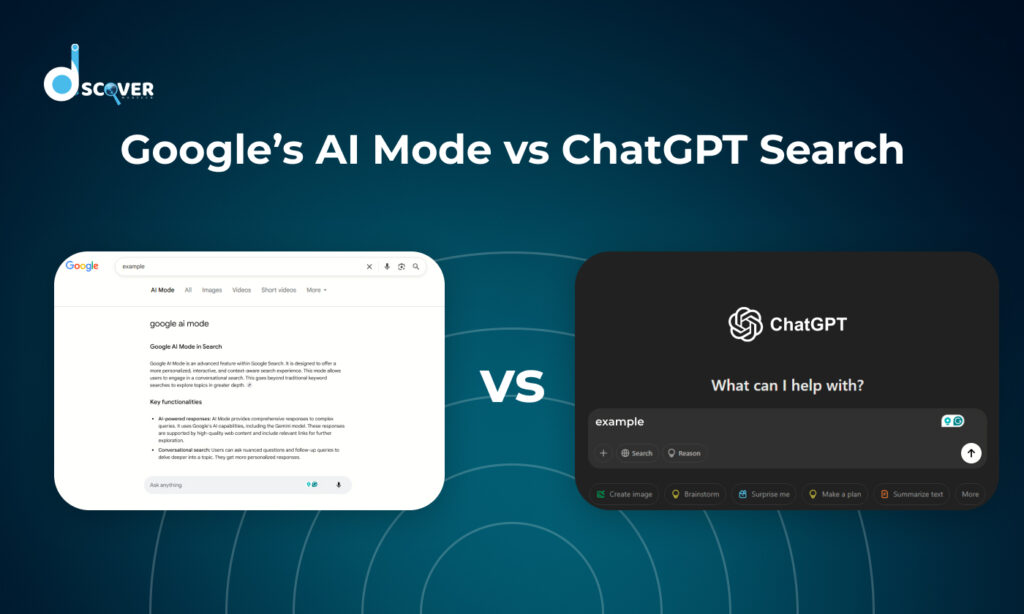
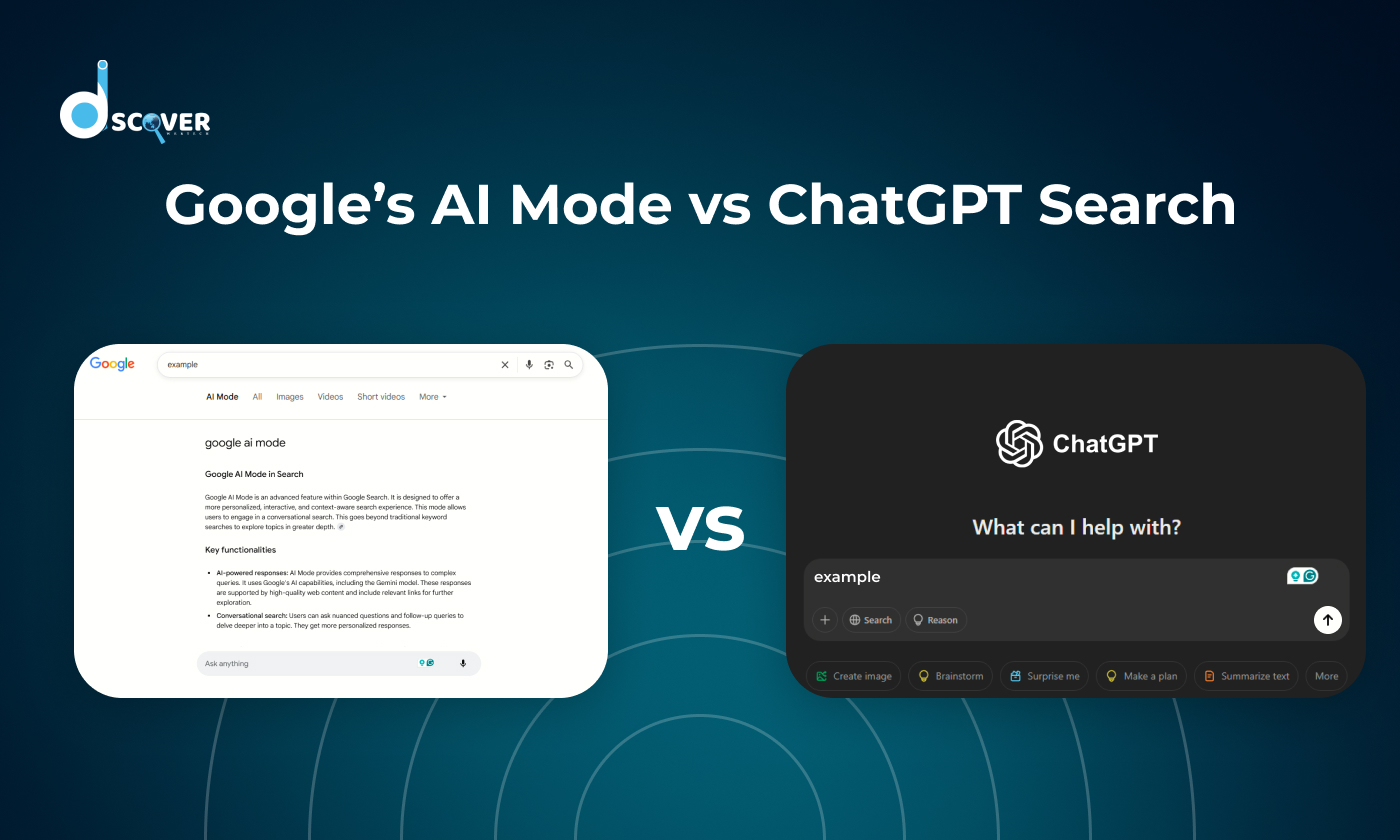
1. The Rise of AI-Powered Search
Search is no longer just about finding links, it’s about finding answers.
For the first time in decades, Google’s dominance in search is facing a real challenge. That challenge isn’t another search engine like Bing, it’s a new form of intelligence. AI-powered tools like Google’s AI Mode and ChatGPT Search are transforming how people discover, verify, and understand information.
The race to own the future of search is now centered on conversation, not just indexing. In 2025, both Google and OpenAI have rolled out powerful AI experiences that aim to go far beyond blue links. But how do these tools actually compare? Which one is better at reasoning, understanding, and helping users get what they’re really looking for?
This blog unpacks that question in full based on real-world tests, technical breakdowns, and a look under the hood of both platforms.
2. What Is Google AI Mode?
Google AI Mode is Google’s boldest move yet toward generative search. Released in May 2025, it reimagines how users interact with search results by fusing large language model capabilities with Google’s traditional index.
Unlike standard search or even AI Overviews, AI Mode invites users into a fluid, conversational space where queries evolve naturally. You ask a question and receive a complete response — not just a list of links. Follow-ups are encouraged, and the interface remembers your context as you go deeper.
2.1 How It Works
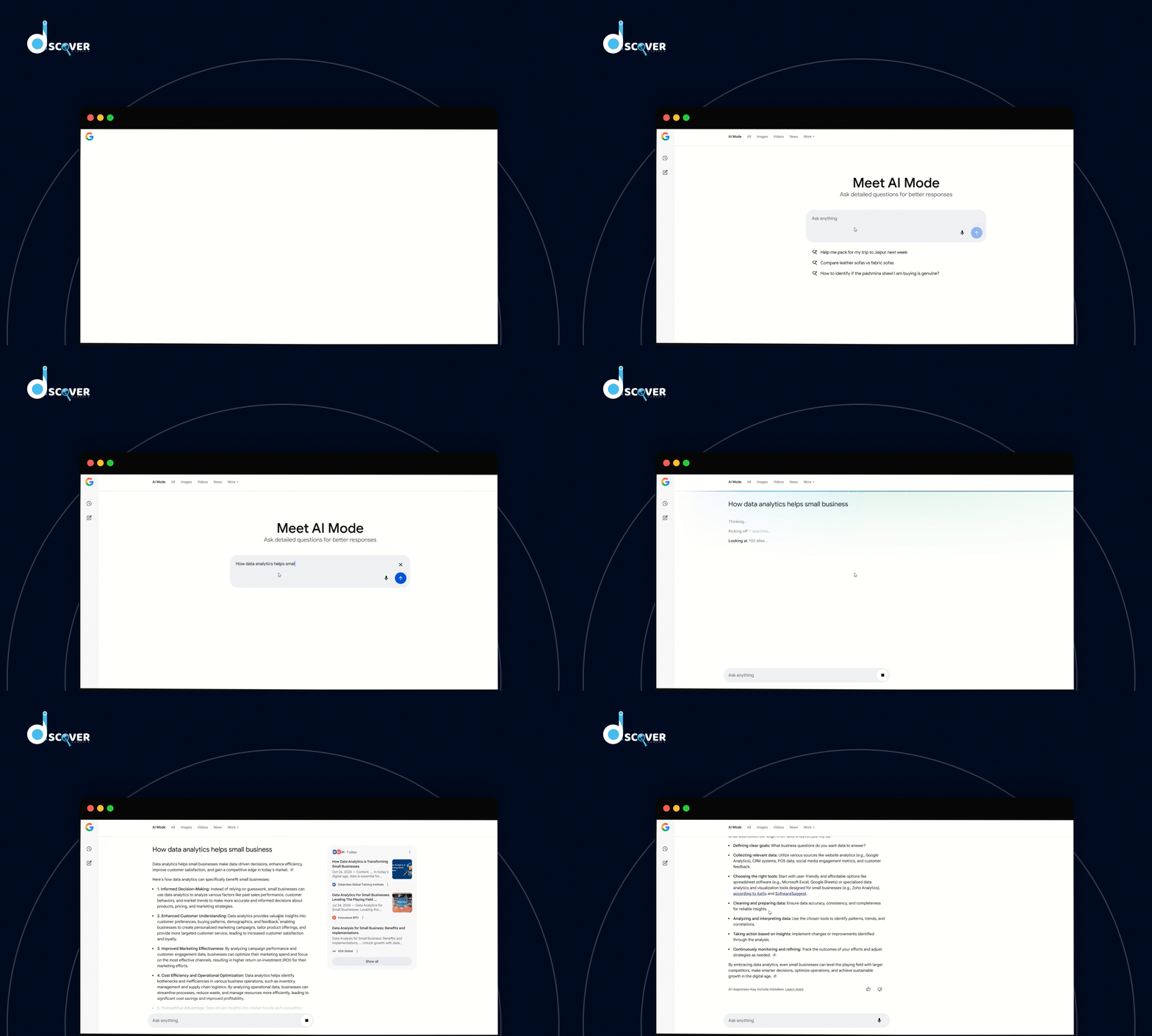
When you activate AI Mode (currently available only in the U.S. India & some other regions.), it appears as a toggle on Google’s homepage. Once enabled, it opens a side panel where you can type in your queries and receive AI-generated answers.
For example, if you search for “best laptop for video editing,” AI Mode provides a synthesized summary of top models, common buyer concerns, and feature comparisons. If you follow up with “What if I’m on a budget under $1,000?” the AI understands the new constraint without needing you to retype the full question.
Responses are based on real-time web data, factual databases like Google’s Knowledge Graph, and previous user inputs. Visuals like maps, product cards, and charts are also embedded directly in the response when relevant.
2.2 Key Technologies Behind It (Gemini, Reasoning, Personalization)
At its core, AI Mode runs on Gemini 2.0, Google’s most advanced multimodal language model to date. But the magic lies in how Gemini is applied. These capabilities are key pillars of AI Development, allowing Google AI Mode to reason, personalize, and evolve like never before.
- Query fan-out: AI Mode breaks down complex questions into subtopics and evaluates multiple dimensions in parallel.
- Structured reasoning: The AI builds logical chains to determine the best response, especially for multi-step tasks.
- Personalization memory: A digital fingerprint called a vector embedding tracks your interactions and tailors future responses based on behavior, preferences, and query history.
Combined, these elements make AI Mode feel more intelligent and intuitive. It’s not just retrieving content it’s thinking through your question.
3. What Is ChatGPT Search?
ChatGPT Search is OpenAI’s advanced conversational search experience designed to bridge the gap between static web pages and dynamic, AI-powered reasoning.
First introduced in late 2022 and significantly upgraded in October 2024, ChatGPT Search now brings real-time results, cited sources, and contextual memory into a single interface. While it started as a chatbot, it now functions as a complete search companion.
3.1 How It Works
Using ChatGPT Search is as simple as chatting with a knowledgeable friend. You type in your question whether it’s about the best email marketing platforms, latest climate laws, or how to cook a vegan lasagna and receive a well-structured, narrative answer with citations.
This service uses a combination of third-party integrations and live search providers, including Microsoft Bing, along with verified content feeds from media outlets like Reuters and The Associated Press.
Where it shines is in its contextual continuity. Ask, “Compare Google AI Mode and ChatGPT Search,” and follow up with, “Which one is better for shopping research?” the AI knows you’re continuing the same thread and responds accordingly.
3.2 Key Technologies (GPT-4o, Bing Integration, o1/o3 Reasoning)
ChatGPT Search is built on GPT-4o, a powerful multimodal model that supports text, voice, image, and file-based prompts. But it’s not just the model that makes the system work.
Key technological components include:
- Bing API integration: Enables live web access to fetch the most current information.
- Reasoning engines (o1 and o3): These models break down user prompts into logical steps, allowing for more thoughtful, structured outputs especially useful in what OpenAI calls “deep research.”
- Media partnerships: Real-time content from reputable publishers ensures fresher, more trustworthy results.
Unlike traditional search engines, ChatGPT is less focused on crawling the entire internet and more on answering your question clearly and quickly even if it means distilling long-form content, summarizing PDFs, or comparing tables.
4. Google AI Mode vs ChatGPT Search: The Full Comparison
Both Google AI Mode and ChatGPT Search are changing the way we discover answers online. They combine AI-powered summaries, real-time awareness, and conversational memory but differ in architecture, style, and purpose.
Below is a refined comparison across key categories that matter most to users and marketers alike.
4.1 User Experience and Interface
The experience of using each tool feels fundamentally different one keeps you in the search world, the other invites you into a conversation.
Google AI Mode:
- Built directly into the homepage; toggle between classic Search and AI Mode
- Layout feels familiar embedded links, maps, carousels, and images
- Follow-up box encourages exploration but remains rooted in SERP-style presentation
ChatGPT Search:
- Offers a clean, chat-first interface zero clutter or distractions
- Better at remembering context across multi-step queries
- Inline citations keep responses transparent and traceable
Summary:
Google gives you a hybrid of Search and AI. ChatGPT offers a pure conversational experience built for deeper engagement, not clicks.
4.2 Answer Quality and Depth
The way each engine generates answers reflects its core philosophy one pulls in citations and sticks to known truths, while the other reasons and interprets.
Google AI Mode:
- Relies on structured data, Knowledge Graph, and web crawling
- Ideal for factual queries: e.g., “symptoms of vitamin D deficiency”
- Tends to paraphrase multiple sources with minimal synthesis
- Prioritizes reliability over originality
ChatGPT Search:
- Powered by GPT-4o with deep reasoning from o1/o3 and Bing
- Ideal for “how-to,” comparative, and strategic queries: e.g., “best remote team tools for startups in 2025”
- Provides nuanced answers, logic flows, and scenario analysis
- May generate ideas or opinions, even if not explicitly found online

Summary: Google is fast, verifiable, and direct, while ChatGPT is layered, personalized, and thoughtful together, they balance quick facts with deeper, conversational insights.
4.3 Personalization and Context Handling
AI search isn’t just about finding facts it’s about understanding you. This is where contextual memory and user behavior shaping come in.
Google AI Mode:
- Uses vector embeddings to influence answers over time
- Shifts results based on prior search behaviors and preferences
- Doesn’t fully retain multi-step conversation threads
- Better at surfacing personalized local results or commerce listings
ChatGPT Search:
- Maintains conversation memory throughout the session
- You can refine, add conditions, or shift angles without repeating yourself
- Feels like an assistant that “knows” what you’re exploring
- Ideal for research, ideation, and layered instructions
Summary: Google adapts results dynamically, while ChatGPT remembers your conversation’s direction together offering both real‑time updates and personalized continuity.
4.4 Real-Time Access and Information Freshness
Timeliness is a major differentiator, especially in news, shopping, or breaking event queries.
Google AI Mode:
- Crawls and indexes the web constantly delivers instant updates
- Pulls from Google News, Maps, YouTube, and Shopping integrations
- Always shows the most recent results (in most verticals)
- Great for questions like “latest iPhone reviews” or “events near me today”
ChatGPT Search:
- Uses Bing Search + select media feeds (AP, Reuters, FT, etc.)
- Good freshness, but not as comprehensive or instantaneous
- May lag behind in niche or fast-developing stories
- Best for general queries rather than urgent updates
Summary: Google excels with up-to-the-minute information, while ChatGPT offers deeper, more reflective knowledge prioritizing depth over immediacy.
5. Deep Research: A New Battleground for Search Engines
5.1 How “Deep Research” Works in Both Systems
AI search is no longer just about fast answers it’s about depth, reasoning, and multi-step problem solving. That’s where “deep research” comes in.
Both Google and OpenAI are investing heavily in reasoning-first search. With Google, deep research is emerging through Gemini 2.0 Flash. These systems don’t just summarize they deconstruct a query, map out research steps, and then pull structured answers backed by facts, schema, and live sources.
OpenAI’s version, known as Deep Research with o3, is already live for ChatGPT Pro users. When enabled, ChatGPT becomes far more methodical: it builds a plan, explains its logic, iterates, and returns a nuanced response that feels like it came from a skilled researcher, not a bot.
What’s important is that both systems try to simulate how a human researcher would work. But their strengths differ:
- Google’s research pulls heavily from the live web and is better for time-sensitive or data-rich searches (like reports, stats, or trends).
- ChatGPT’s deep research excels when queries are more conceptual, strategy-focused, or require multi-step reasoning.
5.2 Sample Prompt Comparison
Let’s test this. Try asking both systems:
“Help me plan a 90-day marketing strategy for a B2B SaaS brand with a $5k/month budget targeting mid-market CFOs.”
ChatGPT Deep Research will likely break this down: define the audience, segment the budget, build timelines, suggest channels, and even recommend metrics all in one thread.
Google AI Mode, while strong, tends to present related resources or summaries without the same integrated reasoning. It may link to blogs or templates, but you’ll have to stitch them together yourself.
The winner? ChatGPT for strategy. Google for speed, freshness, and verification.
6. Limitations and Risks
6.1 Mistakes and Hidden Flaws in AI Results
AI tools like Google AI Mode and ChatGPT often sound confident—even when they’re wrong. This issue, called hallucination, can lead to misleading or outdated answers.
Google AI Mode uses real-time data and its Knowledge Graph to limit these errors, but issues still show up especially on evolving topics.
ChatGPT, particularly in reasoning-heavy queries, is more likely to make factual mistakes, especially in areas like health, science, or law.
Both tools can also reflect hidden assumptions from their training data, leading to biased or one-sided results on sensitive subjects.
AI search is powerful but not perfect. Always double-check critical information.
6.2 Privacy and Data Implications
With these AI systems acting like conversational assistants, what you type in matters and it might be remembered.
- ChatGPT has memory features (you can toggle them off), and prompts may be used to improve the model unless you opt out.
- Google AI Mode doesn’t currently store ongoing chat history in the same way, but your queries may be logged to personalize future results.
In both cases, users should assume queries are not entirely private. Sensitive topics? Proceed with caution.
7. Which One Should You Use And When?
7.1 Use Cases by Intent
Here’s a quick breakdown by intent:
| Intent | Best Tool | Why |
| Research & Strategy | ChatGPT Search (Pro) | Maintains context, reasons deeply, builds outlines |
| Breaking News & Trends | Google AI Mode | Live data from the web, integrated with news/media |
| Shopping & Local Queries | Google AI Mode | Shopping graphs, Maps integration, product data |
| Learning New Concepts | Both (depends) | ChatGPT for detail & examples, Google for source credibility |
7.2 Final Verdict (Not a Winner-Takes-All)
If your goal is speed, Google’s AI Mode feels familiar and grounded. If your goal is depth, ChatGPT brings unmatched conversational fluidity and structured reasoning.
Neither system will “kill” the other. In fact, the smartest users are already flipping between both daily using one to explore, the other to validate.
The future isn’t one search engine to rule them all. It’s a flexible, blended stack of AI tools, each optimized for different types of questions, goals, and decision styles.
Conclusion: AI Search Is the Future But Style Matters
We’re witnessing the biggest shift in search since Google’s creation. But this time, it’s not just about crawling faster or ranking higher it’s about understanding better.
Google’s AI Mode represents everything search has learned: structured, scalable, and grounded in the live web. ChatGPT represents where search is going: adaptive, conversational, and capable of synthesizing insight.
In the end, AI search isn’t about which engine is smarter. It’s about which one matches your intent and whether you’re ready to collaborate with it, not just query it.
The search bar is dead. The AI interface is here. And how you use it… will define the results you get.
FAQ
Can I use Google AI Mode outside the U.S.?
Yes. As of mid-2025, Google AI Mode is now available in India and several other regions. You’ll still need to be signed in with a personal Gmail account, and the experience is currently limited to English. Workspace accounts and non-English queries may not be fully supported yet.
Is ChatGPT better for in-depth research?
For long-form or exploratory research, ChatGPT (especially Pro mode) often performs better. Its Deep Research feature breaks queries into subtasks and reasons through them, which is ideal for brainstorming, summarizing, and comparing concepts. That said, always verify facts — ChatGPT isn’t a substitute for expert sources.
Which is more helpful for product searches and comparisons?
Google AI Mode is more reliable for product-based queries. It integrates real-time pricing, reviews, and shopping listings directly into responses. ChatGPT can explain features or help with decision-making frameworks, but it doesn’t consistently access the latest product data or eCommerce feeds.
Do both tools support follow-up questions?
Yes, but differently. ChatGPT maintains deeper conversational memory, allowing complex multi-step threads. Google AI Mode handles simple follow-ups within a session, but doesn’t yet retain long-term context or personalize beyond the immediate search.
Are responses from both tools sourced or cited?
Both platforms include sources. Google typically shows clickable links or tiles beneath the AI response. ChatGPT includes inline citations and links, making it easier to verify or dig deeper especially useful when accuracy matters.