
At Discover WebTech, we work with clients across industries who often ask us: how does a marketing funnel work? Or even more foundational—what is a marketing funnel and how to make a marketing funnel that converts?
We’ve seen firsthand that the marketing funnel isn’t just a concept—it’s the framework that powers consistent and predictable growth for businesses of all sizes. In this blog, our team members walk you through the entire funnel, share actionable strategies, and show why every business needs one.
What Is a Marketing Funnel?
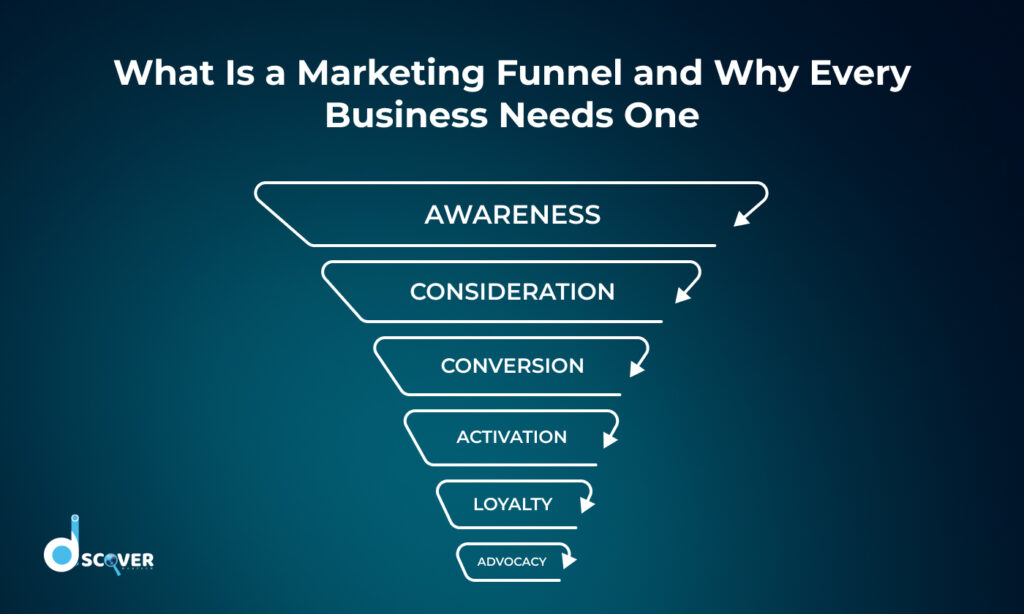
According to a marketing expert, a marketing funnel is the journey a potential customer takes from first discovering your brand to becoming a loyal buyer and advocate. This journey can be broken down into distinct stages:
- Awareness
- Consideration
- Conversion
- Loyalty
- Advocacy
The marketing funnel explained helps us identify what type of content, message, or strategy fits best at each step. It’s a roadmap that ensures you don’t miss the chance to move someone from curiosity to conversion.
How Does a Marketing Funnel Work?
We often tell our clients that the funnel is like a story—they’re the main character, and we’re the guide helping them solve a problem.
Here’s how it typically works:
Top of Funnel (ToFu): At this stage, we focus on creating awareness. Our team members use tactics like SEO, blog posts, and social media to drive visibility.
Middle of Funnel (MoFu): Once we’ve earned interest, we nurture it. This is where we share lead magnets, email sequences, product comparisons, and case studies.
Bottom of Funnel (BoFu): This is where prospects are ready to make a decision. We offer free trials, demo calls, or limited-time offers to encourage conversion.
After conversion, the funnel doesn’t stop. We continue nurturing through loyalty programs, onboarding, and referral campaigns to turn buyers into brand advocates.
Why Every Business Needs a Funnel
Here’s why we believe every business should implement a marketing funnel:
It helps measure what matters: Funnels allow us to see drop-off points and fix them. If lots of visitors reach your site but don’t convert, we know exactly where to look.
It improves message alignment: By delivering stage-specific messaging, we avoid overwhelming leads with too much information too soon—or too little, too late.
It aligns marketing and sales: Our team members collaborate across departments using funnels as a shared language. Marketing brings in leads, and sales closes them.
It builds customer loyalty: Funnels don’t end at purchase. We integrate post-purchase engagement strategies that increase customer lifetime value.
It scales marketing efforts: Automation within the funnel helps generate results 24/7. We free up time while still capturing, nurturing, and converting leads.
How to Make a Marketing Funnel: Step by Step
We use a structured approach when guiding clients on how to make a marketing funnel:
Identify your audience
We start by building detailed buyer personas. Who are they? What challenges do they face? What solutions are they searching for?
Set clear funnel goals
We determine specific goals for each funnel stage. For example, increasing awareness by 30%, generating 500 leads per month, or converting 5% of webinar attendees into buyers.
Build your funnel content
We tailor the content for each stage:
- ToFu: Educational blog posts, lead magnets, SEO articles
- MoFu: Case studies, webinars, email campaigns
- BoFu: Demos, consultations, exclusive offers
- Post-purchase: Onboarding sequences, loyalty programs, and referral rewards
Set up your tools
We use tools like landing page builders, CRM systems, automation software, and analytics platforms to make the funnel seamless and trackable.
Launch and promote
Once live, we distribute content via search engines, social media, ads, partnerships, and more.
Track and optimize
Using tools like Google Analytics and CRM reports, we track each stage’s performance. Then we optimize weak points—whether it’s the message, design, or offer.
The Marketing Funnel Explained Using AIDA
We also explain how does a marketing funnel work by mapping it to the AIDA model:
- Attention: Capturing the audience’s interest with valuable, engaging content
- Interest: Building curiosity and trust through deeper, more informative content
- Desire: Presenting compelling solutions to their specific problems
- Action: Encouraging the next step—buy, sign up, schedule, or subscribe
This model reinforces what we do in each stage of the funnel and ensures the messaging flows logically.
Common Funnel Mistakes & How to Fix Them
Through client projects, we’ve seen some common pitfalls:
Overcomplicating the funnel
Simple funnels often perform best. If there are too many stages or touchpoints, we simplify for clarity.
Ignoring the data
Without tracking conversions, bounce rates, and open rates, a funnel loses power. Our team always tests, tweaks, and repeats.
Using generic messaging
Stage-agnostic content can alienate leads. We ensure every message matches the user’s intent and stage in the journey.
Overlooking post-purchase
Many brands stop engaging once the sale happens. We believe this is the time to deepen the relationship, not walk away.
Real-World Funnel Examples
Here are a few funnel structures we’ve built for clients:
E-commerce brand:
SEO article → Email opt-in → 10% off offer → Purchase → Loyalty rewards
SaaS business:
LinkedIn ad → Free ebook → Webinar → Free trial → Monthly subscription
B2B service:
Blog post → Case study download → Consultation offer → Proposal → Contract signed
The beauty of the funnel is that it can be adapted to fit nearly any business model or industry.
Optimizing Your Funnel for Better Conversions
We continuously test and optimize every funnel component. Here are strategies we use:
- A/B testing subject lines, landing page CTAs, and visual layouts
- Segmenting email lists by behavior and funnel stage
- Using lead scoring to prioritize follow-up efforts
- Automating follow-ups with drip campaigns, reminders, and upsell messages
- Encouraging referrals by offering value-driven incentives
This ongoing optimization helps us improve conversion rates month after month.
Conclusion: Start Building Your Funnel Today
We hope this blog gave you clarity on how does a marketing funnel work, and more importantly, how it can work for you.
At Discover WebTech, we use funnels to attract the right audience, convert them into loyal customers, and keep them engaged long after the first sale. Whether you’re just learning how to make a marketing funnel or want to optimize an existing one, we’re here to help.
The marketing funnel explained isn’t just theory—it’s the practical system we use every day to drive growth for our clients.
Ready to start building yours? Our team members are happy to help create your custom funnel strategy. Let’s turn your traffic into conversions and your customers into brand ambassadors.
Check out our latest blog on “The Ultimate Guide to Link Building for eCommerce Websites”